
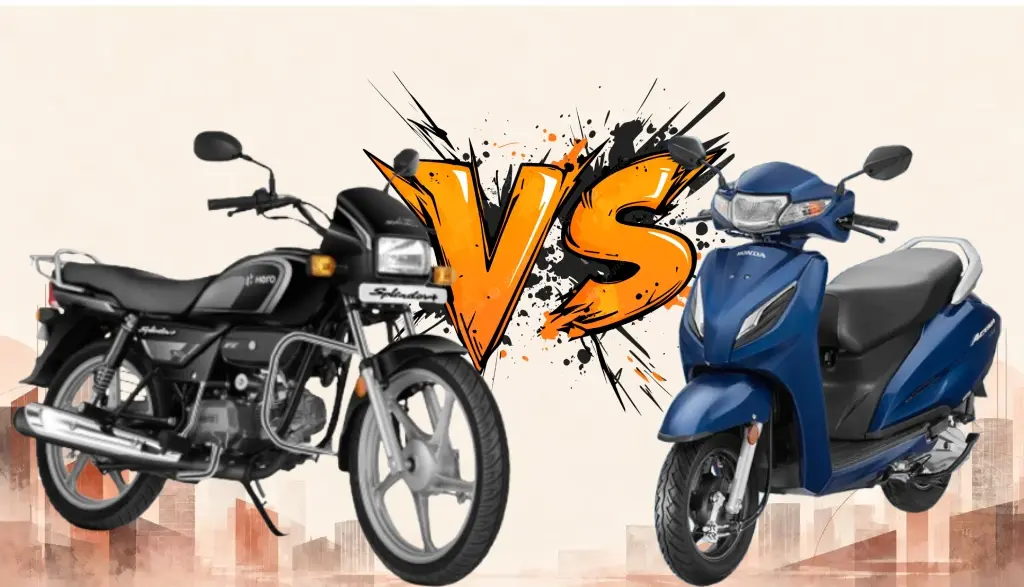
Commuter bike vs scooter: which suits your everyday ride?

Key highlights
- Scooters offer easier city riding, automatic transmission and useful storage.
- Commuter bikes provide larger wheels, bigger fuel tanks and better mileage
- The Splendor Plus and Activa 110 start at nearly the same price
Outline
Imagine a Hero Splendor Plus and a Honda Activa 110 stopped at the same red traffic signal. While one rider has a gear stick below his left foot, the other has both his feet placed on the footrests. Both produce less than 8 bhp and reach the office destination point. The bike or scooter dilemma is a question of preference, but it actually depends on the roads you choose, your baggage and your right hand. Here is how they stack up, with verified figures.
Conclusion: Go for the scooter if you commute in urban areas, carry a daily bag, and hate gear shifting. Commuter bikes suit you if you ride on uneven roads, need to cover longer distances, or are concerned about fuel costs. In 2026, the Hero Splendor Plus and the Honda Activa 110 cost almost the same.
How a motorcycle and a scooter really differ
On a commuter motorcycle, power goes through a wet clutch into a gearbox with four or five ratios, then to the rear wheel by chain. You choose the gear. Through sound and vibration, the engine tells you when it wants another. A scooter replaces all of that with a continuously variable transmission (CVT). Two pulleys and a rubber belt change their working diameters on their own, so the engine stays near its useful revs while the scooter picks up speed. No lever, no shifting and nothing to stall at a signal.
Placement matters too. In the Honda Activa 110, the engine and drive unit are bolted to the rear swingarm and move with the wheel, an arrangement Honda calls a unit swing. Hero’s Splendor Plus instead holds its engine in a tubular double-cradle frame, so less weight bounces up and down with the rear wheel.
Belts and pulleys also lose a little more energy to friction than a chain does. That is one reason a 109cc scooter usually returns less mileage than a 97cc motorcycle making the same power.
Commuter bike and scooter comparison at a glance
On paper, these two are closer than most buyers expect, making them a fair pair to measure.
| Specification | Hero Splendor Plus | Honda Activa 110 |
| Engine (cc) | 97.2 | 109.51 |
| Power (bhp) | 7.91 | About 7.9 |
| Transmission | 4-speed manual | Automatic CVT |
| Fuel tank (litres) | 9.8 | 5.3 |
| Kerb weight (kg) | 112 | 106 |
| Seat height (mm) | 785 | 765 |
| Ground clearance (mm) | 165 | 162 |
| Wheels | 18-inch front and rear | 12-inch front, 10-inch rear |
| Under-seat storage | None | About 18 litres |
| Mileage (kmpl) | 60 to 63 | 47 reported by owners, 54 city and 66 highway in a road test |
| Starting ex-showroom price (₹) | About 77,000 | About 76,000 |
Power is a dead heat. Weight favours the scooter by 6 kg, and the seat sits 20 mm lower. The big gap is the tank. With 9.8 litres, the Splendor Plus covers close to 590 km on paper at 60 kmpl. Activa’s 5.3 litres, of which 1.3 are reserve, lasts about 250 km at the 47 kmpl owners report. In return, only the scooter gives you a proper storage bin under the seat.
Also Read: https://www.bikes24.com/news/comparisons/hero-xtreme-160r-4v-carbon-vs-bajaj-pulsar-n160-ss-comparison/
Ride comfort and handling on real roads
It is in wheel sizes that lies the deciding factor in the battle between commuter bike and scooter. The Splendor Plus has wheels measuring 18 inches at each end. The Activa is equipped with 12 inches at the front end and 10 inches at the back end. Large wheels engage potholes at a smaller angle, thus being able to glide over them, while small wheels engage at a steeper angle, resulting in a bump and requiring more focus from the rider on uneven road surfaces.
At lower speeds, the scooter gives back. This is due to the flat floor that allows you to ride the scooter while sitting straight up and stepping off the vehicle without swinging any leg over. The seat height is 765 mm compared to 785 mm. You would have an easier time if you are shorter because you can get more of your feet on the floor.
When the road widens, the bike becomes more secure. The rider can use their knees to hold the fuel tank, can lean lower in the chassis, and the larger wheels track well in the bumpy spots. Riders who ride long distances on a commuter bike always say that they no longer miss their scooters.
Both are light, both use tubeless tyres, and both rely on drum brakes with combined braking. Neither will be thrilling. Both will be easy.
Bike or scooty: which is better for your daily route?
If you have a short journey that consists of many signals and finishes with luggage that must be stored somewhere, the scooter works since the storage compartment can take care of the small bag and the flat floor would be suitable for a rider who is dressed formally. Scooty originated from the name of a model of TVS, but scooty has been used by riders in many cities to refer to any gearless scooter.
If you encounter patches of road where the surface is broken, if you have speed bumps very frequently at an interval of a few hundred meters, or if there is monsoon rain, then it might be better for you to use the bigger wheels of a motorcycle. This would also apply to the case of your rides of thirty kilometres every day in both directions. Bigger tanks mean that you refill gasoline less frequently.
Learners and riders who dread the clutch should lean towards the scooter. Anyone who likes feeling the engine through a clutch and a gear lever will be happier on the Hero Splendor Plus.
Mixed routes are the grey zone. A rider who does eight city kilometres on weekdays and a weekend run to family can honestly pick either. In that case, let the worst road you ride regularly decide.
Fuel economy and running cost in the bike vs scooty fight
As far as fuel efficiency is concerned, the motorcycle has an advantage but only by a slim margin as compared to what is generally thought to be the case. As reported in a published test drive report for the Honda Activa 110, the fuel efficiency of the bike was measured to be 54.4 kmpl in urban areas and 66.2 kmpl on highways. On the contrary, owners state that they generally get around 47 or 48 kmpl in a regular drive. The fuel efficiency of Splendor Plus is estimated to be around 60 kmpl.
Take a round ₹100 per litre. At 60 kmpl, the Splendor Plus costs about ₹1.67 per kilometre. At 47 kmpl, the Activa costs about ₹2.13 per kilometre. Over 1000 km, that gap is roughly ₹460. Ride 1000 km a month and the scooter costs about ₹5,500 more a year. If the scooter manages its 54 kmpl city figure, the gap shrinks to around ₹170 per 1000 km.
Fuel alone rarely justifies the choice. Comfort, storage and ease of use weigh just as heavily, and for plenty of riders a scooter’s convenience easily outweighs a few thousand rupees a year.
Maintenance: which one is easier to look after?
A motorcycle has a chain. It needs cleaning, lubricating and adjusting, and Hero’s own schedule for the Splendor Plus Xtec asks for that every 2000 km. A neglected chain wears the sprockets and rattles at low speed. A scooter has no chain, but its belt and rollers wear over time, and the belt needs inspection and eventual replacement.
Everything else is delightfully plain. Both run simple single-cylinder engines with drum brakes and tubeless tyres, so a plug repair can get you to a workshop after a puncture. Honda recommends 10W30 engine oil for the Activa 110, and the oil change is the one job you should never push back on, whichever machine you ride.
Skipped services show up in mileage first and refinement next. Pick the model with a service centre close to your home, and the maintenance question mostly answers itself.
Price, GST and the safety rules you should know
GST on two-wheelers up to 350cc fell from 28% to 18% on 22 September 2025. Honda said its range would get cuts of up to ₹18,800, and its list price put the Activa 110 reduction at ₹7,874. Today, a 110cc scooter and a 97cc motorcycle start at almost the same figure, and commuters with 100cc engines start lower still. An EMI calculator will help you test the monthly outgoings.
When it comes to braking, combined braking has been mandatory for two-wheelers under 125cc since 2019, while ABS has been mandatory above 125cc. The Splendor Plus and Activa 110 are fitted with drum brakes that have combined braking systems. The idea of making ABS mandatory for all new two-wheelers was introduced in January 2026, but we did not find any confirmation in the reports reviewed.
Any commuter bike and scooter comparison should close with one honest note. A good helmet and proper riding gear matter more than any spec on this page.
Choose by the path you take, not by instinct.
Two questions settle most of this. How rough is your road, and how far do you ride in one stretch? "Smooth and short points at the scooter, whereas rough and long point to the bicycle." Where the two are equal, the preference is for the motorcycle since big wheels and tanks accommodate errors well. Nobody should buy based only on a spec sheet, either. Whatever the commuter bike vs scooter result is for you, sit on both, ride both for ten minutes.