
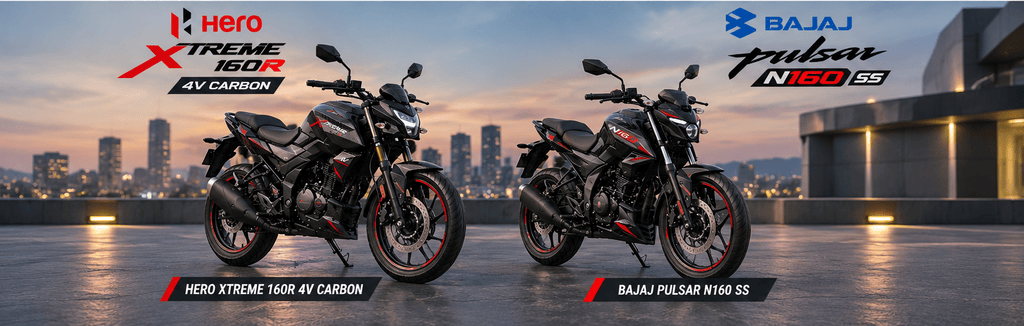
Hero Xtreme 160R 4V Carbon vs Bajaj Pulsar N160 SS Comparison
Key highlights
- Bajaj Pulsar N160 SS delivers 18.24 bhp and advanced rider aids.
- Hero Xtreme 160R Carbon features cruise control and a TFT display.
- Compare pricing, mileage, comfort and features of both 160cc bikes.
Outline
The Hero Xtreme 160R 4V has been a quiet player for the past three years in the 160cc category. Stylish and affordable, it has always been the third player in the discussion after Apache and Pulsar. The updated 160R, unveiled on 16th October, features a sleeker body, cruise control that none of its rivals in the same category offer, and a new premium Carbon version with a TFT screen. The Carbon model is priced at Rs 1.41 lakh (ex-showroom). Although Hero describes it as an introductory price, the Carbon will only be available from November onwards.
Across the aisle sits the Pulsar N160 SS, the fully loaded version of the four-valve N160 that Bajaj launched in August. It is priced at Rs 1.43 lakh in Delhi (Rs 1,42,585, to be exact), makes the most power in the class, and packs a feature sheet that is hard to argue with.
Hero Xtreme 160R 4V Carbon vs Bajaj Pulsar N160SS Price Comparison
| Specification | Hero Xtreme 160R 4V Carbon | Bajaj Pulsar N160 SS |
| Ex-showroom price | Rs 1.41 lakh (introductory) | Rs 1.43 lakh (Delhi) |
| Engine | 163.2cc, single-cylinder, four-valve, oil-cooled | About 165cc, single-cylinder, four-valve, oil-cooled |
| Power | 16.86 bhp at 8,750 rpm | 18.24 bhp at 9,500 rpm |
| Torque | 14.6 Nm at 6,500 rpm | 14.4 Nm at 8,000 rpm |
| Gearbox | 5-speed | 5-speed |
| Kerb weight | 149 kg | 151 kg |
| Seat height | 805 mm | 795 mm |
| Ground clearance | 165 mm | 165 mm |
| Wheelbase | 1,329 mm | 1,348 mm |
| Fuel tank | 12 litres | 14 litres |
Read that quickly, and it looks like a draw. But if you look again, the Bajaj has the extra power, two extra litres of fuel and a seat that sits 10 mm lower. Hero's counter is a bike that weighs 2 kg less and has a slightly shorter wheelbase, which is a hair's breadth in practice.
Sharp Hero, Familiar Pulsar
Hero did not just touch up the Xtreme. Compared with the outgoing Combat Edition, the whole silhouette is sharper, and the change is easiest to spot on the tank and the rear seat cowl. The Carbon comes in four colours.
- Carbon Red
- Carbon Black
- Carbon Grey
- Abrax Orange
The orange is the loud one. The other three are for people who would rather the bike spoke only when the throttle opens.
However, the Pulsar goes about it in a different way since there is nothing revolutionary here. It sticks to the muscle tank with sharp shrouds, the projector headlight with LED daytime running lights, the gold-coloured USD fork, the split seats and multi-coloured spoked alloys, and it takes a lot of attitude from the bigger N250. However, when the N160 was launched, it did not sell like hotcakes, and its appearance has been called neutral by the reviewers. The SS relies on colours rather than dramatic looks. They are available in Atlantic Blue, Pearl Metallic White, and Brooklyn Black, all of which come in different rim colours.
In terms of looks, it is purely a matter of personal taste which one looks better. The Hero looks like it is resting on an angle when it is parked. The Pulsar looks grounded, as if it were a big bike that got shrunk somehow.
Where the Power Lives
The engine is still the 163.2cc oil-cooled single, and peak power has gone up by a token 0.19 bhp to 16.86 bhp, now arriving 250 rpm higher in the rev range. Torque is unchanged at 14.6 Nm.
Bajaj did proper work. The old two-valve N160 made 15.78 bhp and 14.65 Nm. The new four-valve motor adds 2.46 bhp and gives up 0.25 Nm, resulting in the most powerful engine in the segment.
- Power: 18.24 bhp against 16.86 bhp.
- Torque: 14.6 Nm against 14.4 Nm, which is nothing. What matters is where it arrives. Hero peaks at 6,500 rpm and Bajaj at 8,000 rpm.
- Power-to-weight ratio: The Pulsar delivers an output of 122.52 hp per tonne and 114.77 hp per tonne for the Hero. The Bajaj is the heavier bike and still comes out ahead by about seven percent.
- Acceleration: Bajaj claims 0 to 60 kmph in 4.5 seconds for the new four-valve N160 range. We have no matching claim from Hero.
Bajaj offers a slip-assist clutch system on all its N160S models. Both bikes have ride-by-wire throttles. The Pulsar N160 SS offers dedicated ride modes, while the Hero Carbon has its own Rain, Road and Sports ride modes.
The Gadget War
This is where Hero has caught up the most. The Carbon is identical to the Pro variant except for one thing: the new TFT display. Hero also kept the cruise control that arrived last year with the Combat Edition.
| Feature | Hero Xtreme 160R 4V Carbon | Bajaj Pulsar N160 SS |
| Display | 4.2-inch TFT | 5-inch TFT |
| Ride modes | Rain, Road, Sports | Rain, Road, Sport, Off-road |
| Throttle | Ride-by-wire | Ride-by-wire |
| Cruise control | Yes | No |
| Traction control | Not listed by Hero | Yes |
| Low speed crawl function | No | Yes, called Crawl Tech |
| Google Maps mirroring | No | Yes |
| Wi-Fi and Bluetooth | Not highlighted at launch | Yes |
| Assist and slipper clutch | No | Yes |
| Adjustable levers | Clutch lever | Levers adjustable |
| ABS | Dual-channel | Dual-channel |
The Hero's party piece is cruise control, and on a 160 it is more useful than it sounds. A long expressway stretch is far less tiring when the right wrist gets a break. Nobody else in this class offers it, and Hero deserves credit for that.
Bajaj answers with sheer volume. The 5-inch TFT mirrors Google Maps, which Bajaj calls a first for a sports motorcycle in India. It also stores documents on the display, adds an extra ride mode and brings traction control. The verdict on the feature war is that Bajaj still has more features, while Hero and TVS fight hard. The Hero's TFT unit is shared with the Xpulse 210, though Hero redesigned the layout to suit a streetfighter.
Brakes, suspension and tyres
| Hardware | Hero Xtreme 160R 4V Carbon | Bajaj Pulsar N160 SS |
| Front suspension | 37 mm USD fork (KYB) | 37 mm USD fork |
| Rear suspension | Monoshock, preload adjustable | Monoshock |
| Front brake | 276 mm disc | 300 mm disc |
| Rear brake | 220 mm disc | 230 mm disc |
| Tyres | Front 100 section, rear 130 section radial, 17 inch | Front 100 section, rear 130 section radial, 17 inch |
Tyres and suspension layout are nearly identical. Hero is the only one using a fork from KYB, a name with real standing among suspension specialists. Bajaj counters with a 300 mm front disc that comes from a class above. Hero's 220 mm rear disc is the smallest of the group.
A small stopping advantage on paper is not the same as better braking on the road, since tyre grip and ABS tuning matter just as much. Still, a bigger front rotor on a heavier, faster bike is exactly what you would hope to see.
Off-road capability
Let us be sensible. Both of these are street bikes on road-biased 17-inch rubber, and neither was built for trails. Hero sells the Xpulse range for that sort of riding. Still, riders do take streetfighters down broken lanes, and gravel stretches to farmhouses, so here is what each brings.
- Ground clearance is identical at 165 mm. For comparison, the TVS Apache RTR 160 4V claims 180 mm.
- The Bajaj has a dedicated Off-road ride mode that softens throttle response on loose surfaces. The Hero has no equivalent mode.
- Crawl Tech on the Pulsar lets it creep forward in a higher gear with minimal clutch input, which helps on slow, awkward ground.
- Traction control on the SS adds a safety net on dusty or damp patches.
- Weight is a wash at 149 kg for Hero and 151 kg for Bajaj. Seat height is 805 mm against 795 mm, so shorter riders will find it easier to put a foot down on the Pulsar.
Bajaj clearly wins in this category because of its extra electronics. The hardware underneath is basically the same.
Daily use and running costs
The Pulsar carries around 14 litres of fuel, while the Hero offers 12 litres. In terms of mileage, the Hero delivers 48 kmpl, and the Pulsar 4V is 51 kmpl. Treat them as brochure numbers. One road test of the SS returned around 35 kmpl in mixed riding, which is a reminder that a rev-happy engine and a heavy right hand do not mix with frugality.
On ergonomics, the published reviews of the SS praise its rider triangle and call it a bike built for the city. Hero's 805 mm seat is 10 mm taller, and its wheelbase is 19 mm shorter at 1,329 mm. We cannot say how the Xtreme feels over a full day until reviewers have spent proper time on it.
Hero Xtreme 160R 4V Carbon vs Bajaj Pulsar N160SS Price Comparison
| Model and variant | Ex-showroom price |
| Hero Xtreme 160R 4V Standard | Rs 1.27 lakh |
| Hero Xtreme 160R 4V Pro | Rs 1.37 lakh |
| Hero Xtreme 160R 4V Carbon | Rs 1.41 lakh |
| Bajaj Pulsar N160 S | Rs 1.34 lakh (Rs 1,33,511) |
| Bajaj Pulsar N160 SS | Rs 1.43 lakh (Rs 1,42,585) |
The prices for the Hero motorcycles are introductory. Carbon costs an extra Rs 4,000 over the Pro for a TFT screen, and that’s an easy choice for anyone who will be spending time staring at their dashboard. The Pro adds Rs 10,000 over the Standard.
However, the N160 S has an economical four-valve engine but lacks traction control, LED DRLs, dual-channel ABS, and a 300 mm front disc brake. On the other hand, the SS costs Rs 9,000 extra over the S variant but offers everything the latter loses, including a TFT display and a radial rear tyre. The older two-valve N160 is also available in three variants ranging from Rs 1.22 lakh to Rs 1.31 lakh.
The Pulsar is already in showrooms. Hero bookings are open at dealerships across the country, and deliveries can be expected from November, just in time for the festive season.
The Scorecard
| Category | Edge |
| Power and performance on paper | Bajaj |
| Cruise control | Hero |
| Display and connectivity | Bajaj |
| Clutch | Bajaj |
| Fork brand | Hero |
| Front brake | Bajaj |
| Fuel capacity and range | Bajaj |
| Weight | Hero, by 2 kg |
| Seat height for shorter riders | Bajaj |
| Price | Hero, by roughly Rs 1,600 |
Pick Your Side
Take the Hero Xtreme 160R 4V Carbon if:
- Cruise control matters to you because your weekends involve highways.
- You like the sharper styling and the orange paint.
- You want a KYB fork and a Hero service network that reaches into every town.
Take the Bajaj Pulsar N160 SS if:
- You want the most power in the class and a clutch that forgives clumsy downshifts.
- Traction control, Google Maps on the dash and a bigger tank sound like real benefits.
- Rough lanes are part of your commute, and a proper Off-road mode and Crawl function would be useful.
Specification-wise, the Pulsar N160 SS is a better bike than its competitor by a significant margin, and not just visually. The Hero Xtreme 160R 4V Carbon is significantly better than its predecessor and has the unique advantage of cruise control. However, it lacks a slipper clutch and superior electronics. Until a full road test is available, it is best to wait for the Hero's deliveries and ride both bikes back-to-back before deciding.