
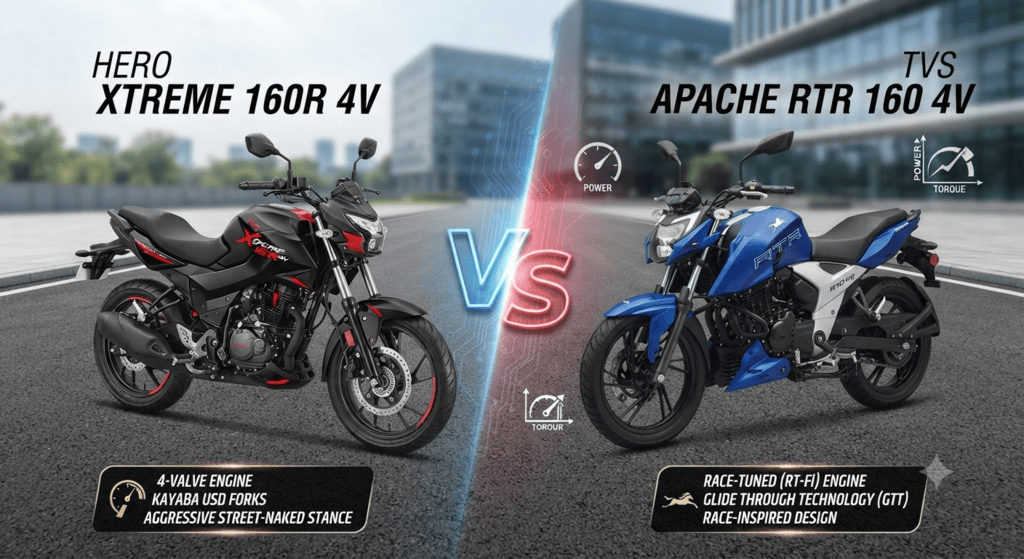
Hero Xtreme 160R 4V vs TVS Apache RTR 160 4V: Which 160cc Bike Should You Buy?
Key highlights
- Apache delivers 17.3 bhp and gets a slipper clutch across variants.
- Hero Xtreme 160R 4V offers 45–50 kmpl and cruise control.
- Apache is lighter, while Hero offers better highway-focused features
Outline
Two street nakeds, both with 12-litre tanks, five gears and top-trim prices that sit almost on top of each other. That is the puzzle in Hero Xtreme 160R 4V vs TVS Apache RTR 160 4V this November. TVS gave the Apache's top trim map-mirroring and a panic brake alert in September, which Hero answered in October with ride-by-wire and cruise control. Both are better motorcycles than they were a year ago. The choice now comes down to features, weight and how you use the throttle every day.
Short answer: Neither of them is a bad choice for sure. The TVS Apache RTR 160 4V makes about 0.4 bhp more, weighs 3 kg less and gets a slipper clutch on every variant and traction control on the top one, whereas the Hero Xtreme 160R 4V counters with higher claimed mileage and cruise control, which the Apache lacks.
Hero Xtreme 160R 4V vs Apache RTR 160 4V: Price Comparison
At the base, the Apache RTR 160 4V price is lower by about ₹1,600, as the single-channel ABS version costs around ₹1,25,440, and the Hero Xtreme 160R 4V Standard variant costs ₹1.27 lakh. All figures are ex-showroom, Delhi, as of November 2026, and Hero has labelled its launch prices as introductory.
| Variant | Hero Xtreme 160R 4V | TVS Apache RTR 160 4V |
| Base | Standard, ₹1.27 lakh, telescopic fork, single-channel ABS | Single-channel ABS, ₹1.25 lakh, telescopic fork |
| Middle | Pro, ₹1.37 lakh, USD fork, dual-channel ABS, cruise control | Dual-channel ABS with USD fork, ₹1.31 lakh, adjustable levers |
| Top | Carbon, ₹1.41 lakh, 4.2-inch TFT | USD with TFT, ₹1.41 lakh, 5-inch TFT, traction control |
The mid-range shows the gap best, where the dual-channel ABS version of the TVS Apache RTR 160 4V costs ₹6,000 less than Hero's Pro, and the Hero Xtreme 160R 4V price premium there pays for cruise control, which TVS does not offer in any trim.
At the top, both of them lie somewhere around ₹1.41 lakh, so money stops being the question.
Engine and Performance: Which Bike Is More Powerful?
Apache’s 159.7cc oil-cooled engine makes 17.55 PS(about 17.3 bhp) at 9,250 rpm, whereas the Hero's 163.2cc four-valve motor makes 17.1 PS(16.9 bhp) at 8,750 rpm. Talking about torque, it is a near tie at 14.7 Nm for TVS and 14.6 Nm for Hero.
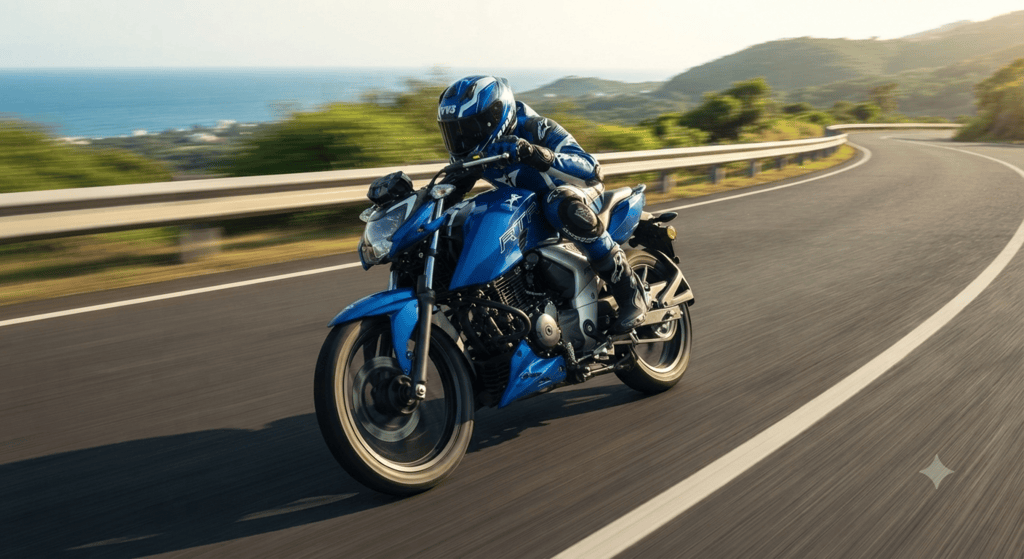
Hero barely touched the engine this year, adding 0.2 PS. The only change is that ride-by-wire replaces the cable with a sensor and a motorised throttle body, introducing Rain, Road and Sport modes along with cruise control. However, only the Pro and Carbon get it.
The weight difference is 3 kg, as the Hero weighs 149 kg, while the Apache weighs about 146 kg. In a Hero Xtreme 160R vs Apache RTR 160 4V sprint from a signal, the TVS should pull slightly harder.
Top speed is a draw on paper. TVS lists 114 kmph in Sport mode and 103 kmph in Urban and Rain, against roughly 115 kmph listed for the Hero.
Hero Xtreme 160R 4V vs Apache RTR 160 4V: Mileage Comparison
TVS certifies 41.4 kmpl for the Apache RTR 160 4V. Hero's own page puts Xtreme 160R 4V mileage at roughly 45 to 50 kmpl, and the certified figures listed for the bike sit in the high 40s.
In real-world conditions, owners commonly report 42 to 47 kmpl from the Hero and 37 to 45 kmpl from the Apache. Tuning is a likely reason, as a motor tuned to rev harder tends to drink more in stop-go traffic, and the Apache's power peak sits 500 rpm higher.
With 12-litre tanks on both, those owner numbers work out to roughly 500 to 560 km on a full tank for the Hero and 440 to 540 km for the Apache. So, in the Hero Xtreme 160R 4V vs Apache 160 4V mileage race, Hero wins by two to five kmpl.
Design, Dimensions and Riding Comfort
Seat height is the first thing shorter riders notice. The Apache sits at 790 mm and the Hero at 805 mm, after Hero lengthened its seat by 16 mm in the update. Ground clearance also favours the Apache, at 180 mm against 165 mm.
Hero's Cybersharp styling is louder, with H-shaped LED lighting at both ends, a sharper tail and a reshaped tank that Hero says grips the knees better, while the Apache keeps its familiar tank extensions and compact shape.
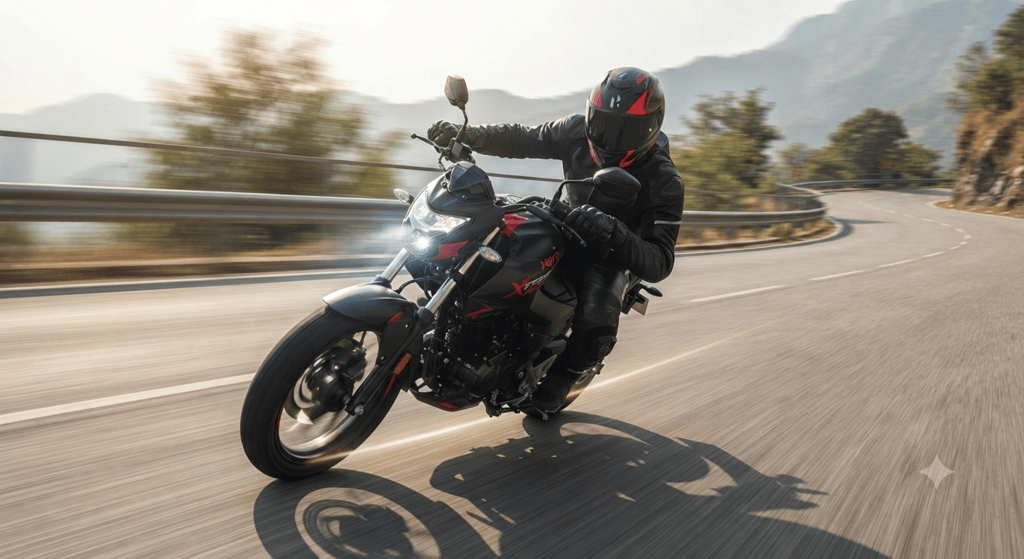
The TVS wheelbase is around 1,357 mm, and Hero stops at 1,329 mm, which should make the Apache calmer on a highway and the Hero quicker to change direction between autos and buses.
Comfort on a long commute? Lower seat, higher ground clearance and longer wheelbase suit the Apache for broken city roads; the Hero suits taller riders and the Apache nearly everyone else.
Features and Technology: Which Bike Offers More?
The features list of the Apache RTR 160 4V is longer, as every variant now gets a Class D projector headlamp, all-LED lighting and an assist and slipper clutch. A slipper clutch lets the plates slip slightly during a hard downshift, so the rear tyre does not hop under engine braking. Top trim adds a 5-inch TFT, traction control, map mirroring, a panic brake alert and a Type-C port. Ride modes are Sport, Urban and Rain, and Glide Through Technology lets the bike creep along in traffic without touching the throttle.
The Pro and Carbon variants of the Xtreme 160R 4V feature cruise control and riding modes including Rain, Road and Sport. On the Carbon, a 4.2-inch TFT shows gear position, shift advice, distance to empty and fuel economy, and pairs over Bluetooth for calls and turn-by-turn navigation. Panic brake assistance, a Type-C charger, hazards light and five-step adjustment levers come included. What it lacks is a slipper clutch and direct map mirroring, and the Standard and Pro keep an LCD.
Cruise control sounds like a toy on a 160 until you hit a long, empty highway stretch. A slipper clutch and traction control are less glamorous, but they help on wet roads and during clumsy downshifts. The Xtreme 160R 4V vs Apache RTR 160 4V features contest therefore splits cleanly. Hero offers the comfort feature, and TVS offers the safety hardware.
Ride Quality, Handling and Braking Performance
Both bikes use a 37 mm USD fork on their higher trims, though only Hero's is made by KYB the suspension specialist, along with preload-adjustable. Entry versions use a telescopic fork and single-channel ABS, and those are the ones to skip. Single-channel ABS only controls the front wheel, so a locked rear in the rain stays your problem.
Up front, the Apache wears 90 mm of tyres against 100 mm on the Hero, and both run 130 mm at the rear. A narrower front generally turns in faster, while a wider one gives a bigger contact patch and a calmer feel.
Hero has a 276 mm front disc and a 220 mm rear, while TVS has a 270 mm front and a larger 240 mm at the rear. However, ABS tuning and pad quality will matter more than disc size. For handling, though, lower weight, a narrower front tyre and more ground clearance point towards TVS
Specifications and Ownership Considerations
The Xtreme 160R 4V and Apache RTR 160 4V specifications sit close together, and the table explains most of the story. Figures are for the top variants unless noted.
| Specification | Hero Xtreme 160R 4V | TVS Apache RTR 160 4V |
| Engine | 163.2cc, four-valve, oil-cooled | 159.7cc, four-valve, oil-cooled |
| Power | 16.9 bhp (17.1 PS) at 8,750 rpm | 17.3 bhp (17.55 PS) at 9,250 rpm |
| Torque | 14.6 Nm | 14.7 Nm |
| Kerb weight | 149 kg | 146 kg |
| Seat height | 805 mm | 790 mm |
| Ground clearance | 165 mm | 180 mm |
| Wheelbase | 1,329 mm | 1,357 mm |
| Fuel tank | 12 litres | 12 litres |
| Brakes, front and rear | 276 mm and 220 mm | 270 mm and 240 mm |
| Claimed mileage | About 45 to 50 kmpl | 41.4 kmpl |
| Clutch | Standard | Assist and slipper |
| Cruise control | Pro and Carbon | Not offered |
| Traction control | Not listed | Top variant |
The Xtreme 160R 4V vs Apache RTR 160 4V specification sheet reads like two near twins with different priorities. Hero spent its money on convenience and TVS on control.
Check the variant before paying a deposit, as the traction control and the TFT on the Apache come only with the top trim, and Hero's cruise control comes only with the Pro or Carbon.
Verdict: Should You Buy the Hero Xtreme 160R 4V or TVS Apache RTR 160 4V?
The verdict on the Hero Xtreme 160R and Apache RTR 160 4V varies according to one's riding environment. Buy the Apache if most of your kilometres are in traffic since it is lighter, sits lower, has the slipper clutch, and its top trim adds traction control. Buy the Hero if highways are part of your week. Cruise control, a mileage lead and a longer range are real advantages there.
One rule helps in the Hero Xtreme 160R 4V vs TVS Apache RTR 160 4V decision. Pick the dual-channel ABS and USD fork trims or higher, and ignore the base versions of both vehicles. Neither is the best 160cc bike in India for every buyer, but the Apache is the safer default and the Hero Pro is the sharper highway tool. If the budget stretches, buyers can also consider the Hero Xtreme 250R at ₹1.98 lakh, which sits a class above both.