
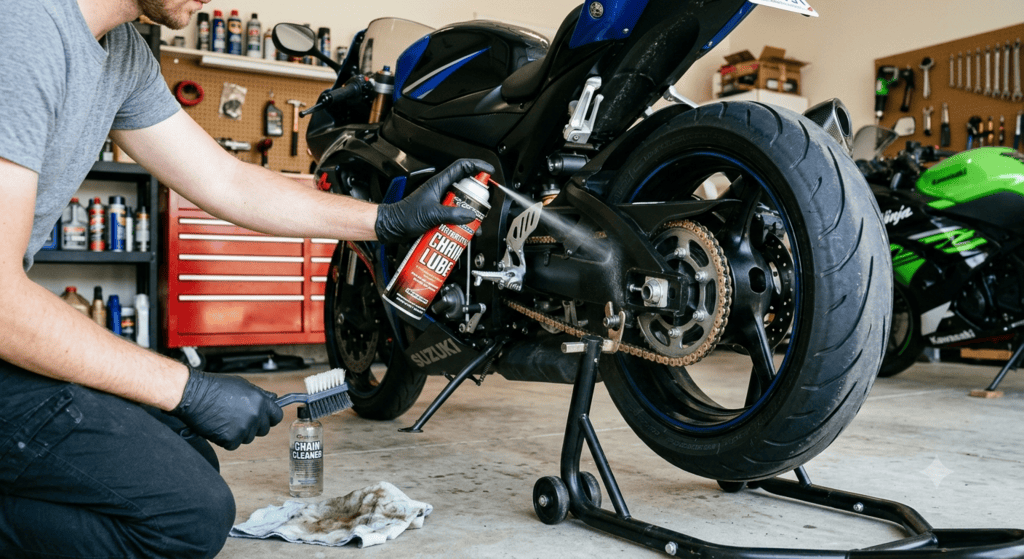
Motorcycle Chain Maintenance: How to Maintain a Motorcycle Chain for Years of Smooth Riding

Key highlights
- Clean and lubricate your motorcycle chain regularly for smoother riding.
- Check chain slack and alignment to prevent premature wear and damage.
- Choose the right chain cleaner and lube to extend chain and sprocket life.
Outline
Most riders generally take care of engine oil and tyre pressure, but ignore one part that sends every bit of power to the road. Your chain takes the full punch of every launch, every downshift and every monsoon puddle. Neglecting it will cost noise, jerks, a stretched drive and a bill for a new chain and sprocket set.
The good news is motorcycle chain maintenance is cheap, quick and easy to do at home. This guide covers how to maintain a motorcycle chain properly, from cleaning and lubing to slack, wear checks, and the best lubes you can buy.
Why Motorcycle Chain Care Matters
A healthy chain is not just about longevity. It changes how the bike feels.
- Smoother power delivery with fewer jerks when you roll on and off the throttle
- Better mileage, since a dry or tight chain wastes energy as friction
- Longer life for the sprockets, which wear out together with the chain
- Lower risk of a snapped chain or a derailed one, both of which can lock the rear wheel or damage the engine casing
- Less noise and fewer vibrations
A chain and sprocket set is a wear item, but how fast it wears is largely in your hands, as it depends on how you drive and maintain the chain.
Know Your Chain Before You Start
There are different types of chains, and their type decides what you can safely use on it.
| Chain type | Where you will find it | Care notes |
| Standard (non-sealed) | Older and some budget commuters | Tolerates most solvents, but needs lube more often |
| O-ring | Most 150cc to 400cc bikes | Rubber rings seal grease inside. Harsh solvents and petrol damage them |
| X-ring | Performance and premium bikes | Same care as O-ring, usually lasts longer |
| Z-ring / sealed variants | Select performance chains | Treat like O-ring |
You will also notice some numbers written on it, such as 428, 520, 525 and 530, these generally describe the chain size.
A 428 is common on 100cc to 160cc commuters, while 520 and 525 are available on bigger machines. The size matters only when you buy a replacement. For maintenance, the rule is simple, if it has rubber seals, go gentle on the chemicals.
Tools and Supplies for DIY Motorcycle Chain Maintenance
You do not need a whole workshop to lube your chain, as a small kit generally sorts the job.
- A paddock stand, rear stand or centre stand (a friend helping you roll the wheel works too)
- Chain cleaner spray, or kerosene and a rag
- A soft nylon brush, or a three-sided chain brush
- Chain lube suited to your riding conditions
- Spanners for the axle nut and adjuster locknuts
- Gloves, because chain gunk stains skin for days
How to Clean a Motorcycle Chain
Most riders generally skip this part, as a fresh lube over old grit makes a grinding paste instead; therefore, cleaning comes first. Here is the motorcycle chain cleaning guide I usually follow.
- Park on a stand with the engine off and the bike in neutral. Never clean a chain while the engine is running.
- Spray chain cleaner along the chain, or wipe it with a rag dipped in kerosene. Let it sit for a minute or two so it can loosen the grime.
- Scrub with the brush, turning the rear wheel by hand to reach every link. Get into the gaps between the plates, not just the outer surface. Again, “don’t clean a chain while the engine is running”.
- Do the same with the front and rear sprocket, as old lube and mud pile up there too.
- Wipe the chain dry with a clean rag. Rotate the wheel and keep wiping until the rag comes away mostly clean.
- Let it air dry for a few minutes. Any leftover solvent will thin out the new lube.
A few things to avoid are petrol, as it can harm O-rings, wire brushes, and high-pressure water jets aimed at the chain, because pressure can force water past the seals and flush out the grease present inside.
What can I use instead of motorcycle chain cleaner?
If you ran out of lube, kerosene on a rag does the job on most chains, and it is the classic garage trick across India. Some riders use a diesel-dampened rag too. Also, dish soap in warm water with a brush works for light dust as well.
Whatever you use, dry the chain fully afterwards and re-lube it the same day. Avoid brake cleaner and petrol on sealed chains.
Popular chain lubes available in India.
These are widely sold in India. Always check that the can says it is safe for O-ring, X-ring and Z-ring chains.
| Product | Type | Good to know |
| Motul C2 Chain Lube Road | Sticky synthetic spray | Easily available, suits all chain types including O, X and Z-ring, and is designed to resist water and not affect seals |
| Motul C1 Chain Clean | Chain cleaner | Chlorine-free formula that works well as the first step before C2 |
| Castrol chain lube | Spray | Easy to find at service centres and accessory shops. A solid everyday option |
| Liqui Moly motorcycle chain lube range | Spray | Imported option with road and racing variants. Check availability and pack sizes |
| Michelin bike chain lube and cleaner combos | Spray combo | Convenient if you want cleaner and lube in one purchase |
| Royal Enfield Essentials chain lube and cleaner kit | Spray kit | Handy for Royal Enfield owners who prefer the brand's own accessories |
| Muc-Off, Maxima and Bel-Ray range | Dry, wax and wet formulas | Imported and a bit pricey, but good for dry-weather or performance use |
Prices swing a lot between pack sizes and online sellers, so compare cost per millilitre instead of the sticker price. Combo packs of cleaner and lube usually work out cheaper than buying separately.
Should you put WD-40 on a motorcycle chain?
No. Regular WD-40 is a water displacer and light penetrating oil. It is not a lasting chain lubricant. It evaporates and leaves the chain under-protected, which is a problem in any weather. It can be used sparingly as a quick cleaner on old chains with no rubber seals, but follow it up with proper lube. For O-ring and X-ring chains, use a chain cleaner and chain lube instead.
How Tight Should a Motorcycle Chain Be?
So, how tight should a motorcycle chain be? Not as tight as you might think. A chain needs some slack to cope with the rear suspension moving up and down. As the swingarm compresses, the distance between the sprockets changes. A chain that is too tight has no room to cope and ends up under constant strain.
Every bike has its own spec, usually printed on a sticker on the chain guard or swingarm and listed in the owner's manual. As a rough guide, sources range from around 20 mm to 40 mm of free play on road bikes. Follow your manual first.
| Condition | What happens |
| Too tight | Strains the chain, sprockets, gearbox output bearing and wheel bearing. Wears everything faster and can snap the chain |
| Correct slack | Smooth power delivery, even wear, quieter chain |
| Too loose | Slapping noise, jerky throttle response, risk of the chain jumping off the sprocket |
How to measure chain slack
- Put the bike on its side stand, on level ground, in neutral.
- Find the tightest spot by rolling the bike forward and checking in several places. Chains rarely wear evenly.
- Push the lower run of the chain up and down halfway between the sprockets, then read off the total movement in millimetres.
- Compare it with the figure in your manual. If the reading is outside the range, adjust.
Some riders prefer to measure with someone sitting on the bike so the suspension is loaded. Check what your manual says for your model.
How to adjust the chain
- Loosen the rear axle nut slightly, and the locknuts on the adjusters if your bike has them.
- Turn both adjuster bolts the same amount. Use the alignment marks on the swingarm as a rough guide, not as the final word.
- Recheck the slack after each small adjustment.
- Tighten the axle nut to the torque listed in the manual, then measure slack once more. Torquing the axle can shift the wheel a touch.
- Check alignment. A crooked wheel makes the chain and sprockets wear on one side. A straight edge or a laser alignment tool makes this easier.
If you are not confident here, any good workshop can do it in minutes.
Motorcycle Chain Care Schedule
These numbers are common recommendations. Dusty, muddy or monsoon riding means you should shorten each interval.
| Task | How often |
| Quick visual check and slack check | Every 500 km, or before a long trip |
| Lube | Every 300 to 600 km, and after riding in rain |
| Full clean and re-lube | Every 500 to 1,000 km in dirty conditions, up to 1,500 km on clean roads |
| Clean the sprocket cover | Every second chain clean |
| Detailed wear inspection | Every 10,000 km, or at every service |
| Alignment check | After any wheel removal or chain adjustment |
Also inspect the chain after a wash, after a ride through water and after any heavy impact.
Signs Your Chain and Sprockets Need Attention
A chain tells you when it is in trouble if you listen and look.
| Sign | Likely cause | Action |
| Rust on side plates | Neglect or water exposure | Clean and lube. If rust persists on rollers, plan a replacement |
| Stiff or kinked links | Seized links, dried grease | Try a clean and lube. If they stay stiff, replace |
| Missing or torn O-rings | Harsh solvents or age | Replace the chain |
| Hooked or shark-fin sprocket teeth | Worn sprocket | Replace chain and sprockets together |
| Slack keeps growing | Chain has stretched | Check for wear, adjust, and plan replacement |
| Clunking or jerks on throttle | Slack, worn parts or dry chain | Inspect and clean, then adjust |
| Chain sounds dry or screeches | Needs lube | Clean and lube |
How Long Does a Motorcycle Chain Last?
A well-looked-after chain and sprocket set often lasts around 20,000 km and can go well beyond that. Some owners on forums report 20,000 km and about five years with regular care. Neglected chains can die far earlier, sometimes before 10,000 km.
What shortens life:
- Skipping cleaning, so grit grinds the pins
- Running too tight or too loose
- Harsh solvents that damage the seals
- Riding in dust, mud and rain without extra care
- Cheap unbranded chains and worn sprockets
- Aggressive launches and heavy loads
Always replace the chain and both sprockets together as a set. A new chain on worn sprockets wears out fast, and the same goes the other way around.
Common Mistakes to Avoid
- The most common mistake is lubing a chain that is still dirty. The grit mixes with the fresh lube and grinds the pins.
- Close behind is the pressure washer, as a hard jet can force water past the O-rings and flush out the grease inside.
- And plenty of riders set slack by eye, which is fine until the chain turns out to be too tight. Wheel alignment gets forgotten even more often.