
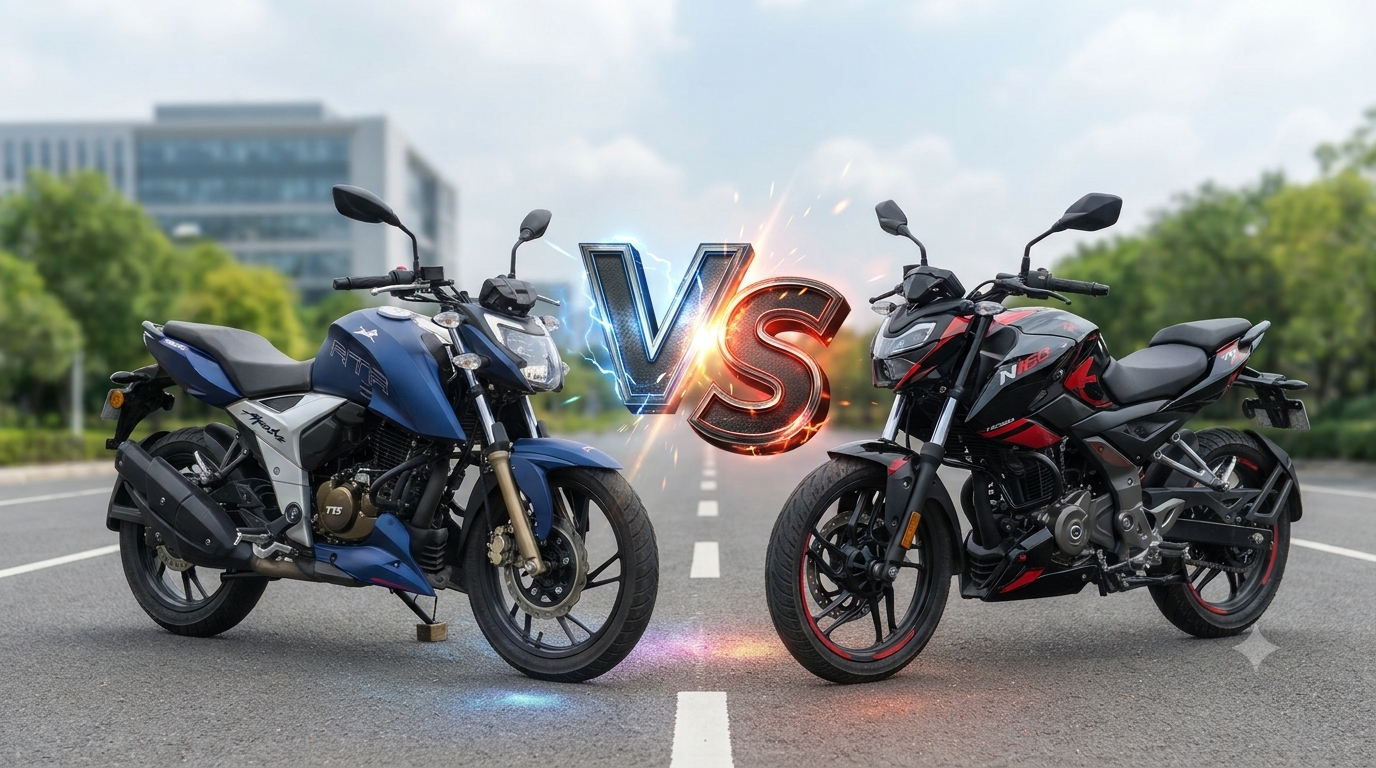
TVS Apache RTR 160 4V vs Bajaj Pulsar N160: Which Is the Better Everyday Sports Bike?

Key highlights
- Pulsar N160 SS offers 18.24 bhp, traction control and ride modes
- Apache RTR 160 4V delivers sharper handling and better overall value
- Both bikes return 40–45 kmpl, making mileage nearly identical
Outline
Ask riders in any service centre queue which 160 to buy, and two names come up first. The TVS Apache RTR 160 4V vs Bajaj Pulsar N160 argument has run since 2022, but 2026 reset it. Bajaj gave the N160 a new four-valve engine in August, and TVS replied in September with Google Maps mirroring on its top Apache.
This article covers price, performance, mileage, comfort, features and running costs as of November 2026, and ends with a straight call.
Short answer: The Pulsar N160 SS is the more complete bike in 2026, with 18.24 bhp, traction control, dual-channel ABS and a 14-litre tank for ₹1,42,585. The Apache RTR 160 4V is lighter, sharper and better value, with dual-channel ABS and a USD fork from ₹1,30,690.
Apache RTR 160 4V vs Pulsar N160: Price and Variants
The Apache RTR 160 4V is the cheaper way into dual-channel ABS, while the Pulsar N160 has the longer price ladder. As of November 2026, TVS sells four main Apache RTR 160 4V variants from ₹1,25,440 to ₹1,41,440. Bajaj sells five Pulsar N160 variants from about ₹1.22 lakh to ₹1,42,585. Prices are ex-showroom, Delhi.
| Variant | Ex-showroom (₹) | Key hardware |
| Apache RTR 160 4V Single-Channel ABS | 1,25,440 | Telescopic fork, single-channel ABS |
| Apache RTR 160 4V Dual-Channel ABS with USD | 1,30,690 | 37mm USD fork, dual-channel ABS, adjustable levers |
| Apache RTR 160 4V USD with TFT | 1,37,440 | Adds 5-inch TFT and traction control |
| Apache RTR 160 4V TFT with Map Mirroring | 1,41,440 | Adds Google Maps mirroring, panic brake alert, Type-C port |
| Pulsar N160 single disc, single seat (2V) | About 1.22 lakh | Rear drum, single-channel ABS |
| Pulsar N160 twin disc, single seat (2V) | about 1.25 lakh | Rear disc added |
| Pulsar N160 twin disc, split seat (2V) | About 1.31 lakh | Dual-channel ABS, 300mm front disc |
| Pulsar N160 S (4V) | 1,33,511 | New engine, ride-by-wire, four ride modes, single-channel ABS |
| Pulsar N160 SS (4V) | 1,42,585 | 5-inch TFT with map mirroring, traction control, dual-channel ABS |
The Apache Dual-Channel ABS with USD and the twin-disc split-seat N160 sit within roughly ₹500 of each other. At the very top, the Pulsar N160 SS costs just ₹1,145 more than the Apache TFT with Map Mirroring. The Pulsar N160 vs Apache RTR 160 4V price gap is close to zero where it matters.
On-road figures swing by state, so check the Apache RTR 160 4V on-road price and the Pulsar N160 on-road price for your city.
Engine and Performance: Which 160cc Bike Feels Sportier?
On paper, the Pulsar N160 4V now wins. Its new 164.5cc oil-cooled four-valve single makes 18.24 bhp at 9,500 rpm and 14.4 Nm at 8,000 rpm. The Apache RTR 160 4V uses a 159.7cc oil-cooled four-valve engine rated at 17.31 bhp (17.55 PS) at 9,250 rpm and 14.73 Nm at 7,500 rpm in Sport mode.
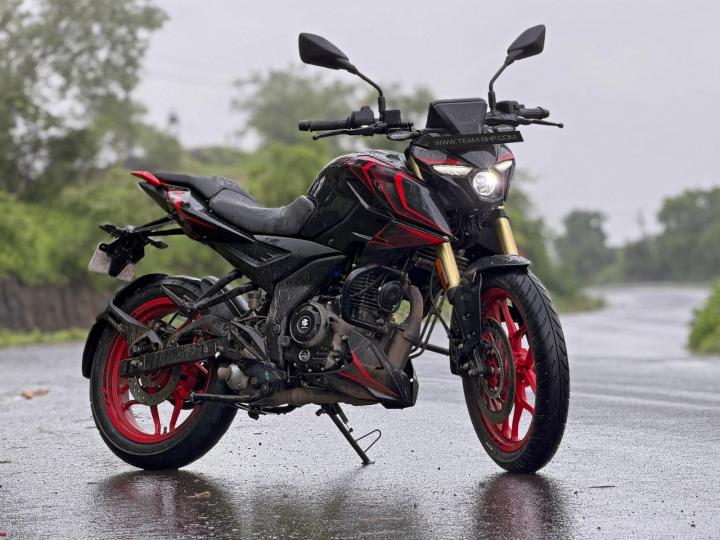
In terms of acceleration, Bajaj claims 0 to 60 kmph in 4.5 seconds, whereas TVS claims 4.8 seconds. The Apache is also lighter, at 146 kg kerb in dual-channel, against 151 kg for the N160 4V. The power-to-weight works out to about 118.6 bhp per tonne for the Apache and 120.8 for the Pulsar.
The reason why the new Pulsar make its torque so high up is that four smaller valves give more total valve area than two big ones, so the engine breathes better at high rpm. Bajaj has used that to push peak power to 9,500 rpm, and peak torque has moved from 6,750 rpm on the 2V engine to 8,000 rpm. The older 2V engine (15.78 bhp, 14.65 Nm) is lazier but more relaxed at low speed in top gear.
The Apache sits in between and gets properly eager past 6,000 rpm. However, the Urban and Rain modes trim output to 15.43 bhp for gentler throttle response on wet tar.
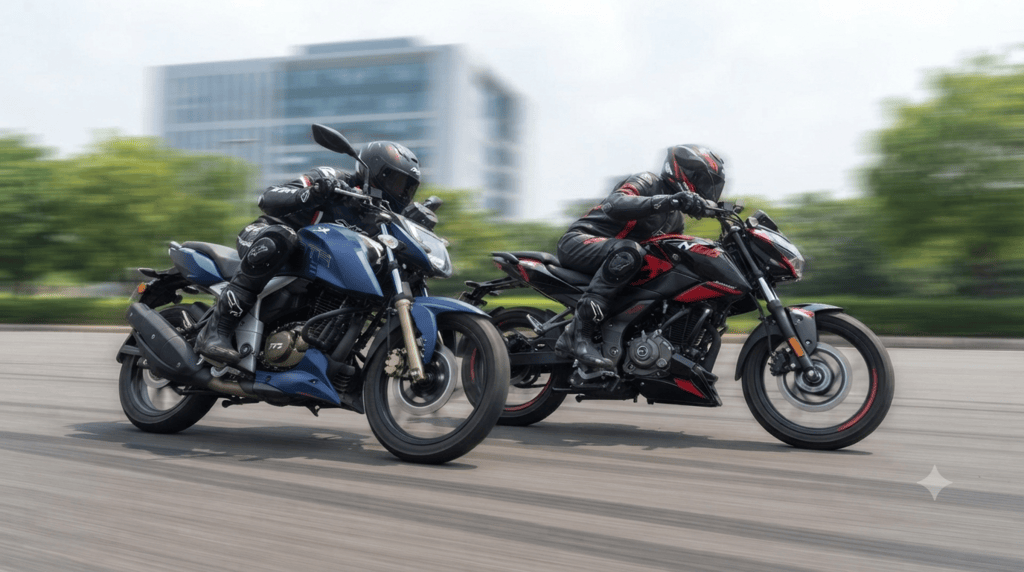
So this was the Apache RTR 160 4V vs N160 performance story. The SS is quicker in a straight line by a small margin, whereas the Apache feels more alive in corners due to its light weight and quick steering. TVS quotes a 114 kmph top speed for its bike.
Apache RTR 160 4V vs Pulsar N160 Mileage: Which Is More Fuel-Efficient?
Fuel efficiency is close enough that it shouldn’t decide your purchase. Owners of both bikes commonly report real-world mileage of around 40 to 45 kmpl in mixed riding.
However, the official numbers are uneven, as Bajaj quotes an ARAI-certified mileage of 51.6 kmpl for the 2V Pulsar N160, whereas TVS doesn’t publish a mileage claim on its Apache RTR 160 4V product page. In independent road tests, the 2V Pulsar does slightly better in stop-start city traffic, at around 43 kmpl, and the Apache stretches past 50 kmpl at a steady highway pace.
One honest gap: the 4V Pulsar has only been on sale since August 2026, so reliable owner figures aren’t in yet, though you can expect it to land close to the Apache. Where the Pulsar wins clearly is range. Its 14-litre tank against the Apache’s 12 litres works out to roughly 630 km against 540 km at 45 kmpl.
Riding Comfort: Which Bike Is Better for Daily Commuting?
The Pulsar N160 is the more comfortable bike for most commuters, and the Apache is the more fun one. The seat heights are nearly identical at 795 mm for the Pulsar and 800 mm for the Apache; it's just that the Pulsar’s seat is a bit broader. Bajaj also reworked the handlebar angle and seat profile on the new SS, giving a slightly more upright stance.
The Apache’s suspension is commonly described as firm, which is great in corners and harsh on broken concrete.
For pillion comfort, the Pulsar’s wider rear seat and extra mass make it steadier two-up, as the Apache’s slimmer, higher tail is less friendly on a 40-minute ride. The Apache has 180 mm of ground clearance against the Pulsar’s 165 mm, so with a pillion and a bag, those 15 mm decide whether the belly pan scrapes on badly built speed breakers.
TVS uses Glide Through Technology, which lets the bike creep forward on idle as you release the clutch. The Pulsar N160 S and SS get Crawl Tech, a ride-by-wire feature that holds a slow, steady pace in a high gear without constant clutch work.
Weigh up the TVS Apache RTR 160 4V vs Bajaj Pulsar N160 for daily use, and the Pulsar edges it on comfort, while the Apache is easier to filter and push around the parking lot.
Features and Technology: Apache RTR 160 4V vs Pulsar N160
At the top end, it’s nearly a draw, but the Pulsar N160 SS has the more advanced electronics. Both flagship variants get a 5-inch TFT with Google Maps mirroring, dual-channel ABS, traction control and a slipper clutch. The Pulsar SS also adds ride-by-wire, which means the throttle sends an electronic signal instead of pulling a cable, enabling its four ride modes (Road, Rain, Sport and Off-road) and Crawl Tech. The braking is handled by a 300mm front disc and a 230mm rear.
The Apache’s top variant has its own extras. Panic brake alert flashes the lights during hard braking to warn traffic behind, and all the variants run a radial rear tyre. The Apache uses 270mm and 240mm petal discs.
The mid-range is where the Apache RTR 160 4V vs Pulsar N160 features comparison turns. For ₹1,30,690, the Apache gives you a USD fork and dual-channel ABS. Spend ₹1,33,511 on the Pulsar N160 S, and you get the new engine and ride modes, but only single-channel ABS. That’s a poor trade for city riders who brake hard in the wet.
Also Read: Hero Xtreme 160r 4V vs Bajaj Pulsar N160SS Comparison
Design and Road Presence: Which Motorcycle Looks Better?
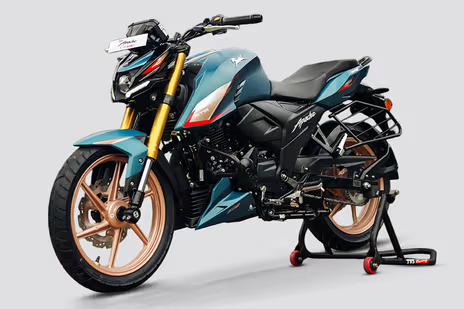
The Apache reads as the leaner sports bike, as it features a sharp, narrow tank and a stubby bullpup exhaust. The new top variant in Arctic Teal with Champagne Gold alloys is the best-looking Apache in years.
The Pulsar is the brawnier street fighter that borrows the bigger N250’s muscular tank shrouds and a bi-functional LED projector headlamp. It looks bigger than a 160cc should. The S and SS come in Atlantic Blue, Pearl Metallic White and Brooklyn Black.
Maintenance, Service Costs and Long-Term Ownership
Neither bike is expensive to keep, and scheduled service bills sit in the same range. The differences lie in parts and engine maturity.
The Apache RTR 160 4V technology is from 2018 and has continued to be improved. The parts are very cheap, and everyone knows it. But the Pulsar 4V engine and its ride-by-wire technology are entirely new. There is no past experience with it.
Some wear items cost more than on a basic commuter:
- Radial rear tyres cost more to replace than standard bias-ply tyres.
- USD fork seals and oil cost more than conventional fork service, and smaller towns may not stock them.
- Chains on both need cleaning and lubing every 500 to 700 km, more often in the monsoon. A tight chain eats sprockets and the gearbox output bearing.
Both brands have a large network of service centres. Check the number of free services and intervals between them in the owner's manual of your specific model. In terms of price-to-value ratio, the Apache is ahead now, but the new Pulsar may be more profitable for resale.
Verdict: Should You Buy the TVS Apache RTR 160 4V or Bajaj Pulsar N160?
Buy the Apache RTR 160 4V Dual-Channel ABS with USD if you want the best value among 160cc sports bikes in India. At ₹1,30,690, it has the hardware that matters.
Buy the Pulsar N160 SS if your budget reaches ₹1.43 lakh and you want the most power, comfort and traffic tech. You can skip the N160 S as the Single-channel ABS at that price is a step backwards.
If you are still wondering which one to buy between the TVS Apache RTR 160 4V and the Bajaj Pulsar N160? Consider this simple thumb rule. Solo riders who love cornering should get the Apache, while pillion carriers riding in traffic every day should go for the Pulsar SS. In case of more confusion, take a test ride on your commuting route. The Hero Xtreme 160R 4V is the third option.