
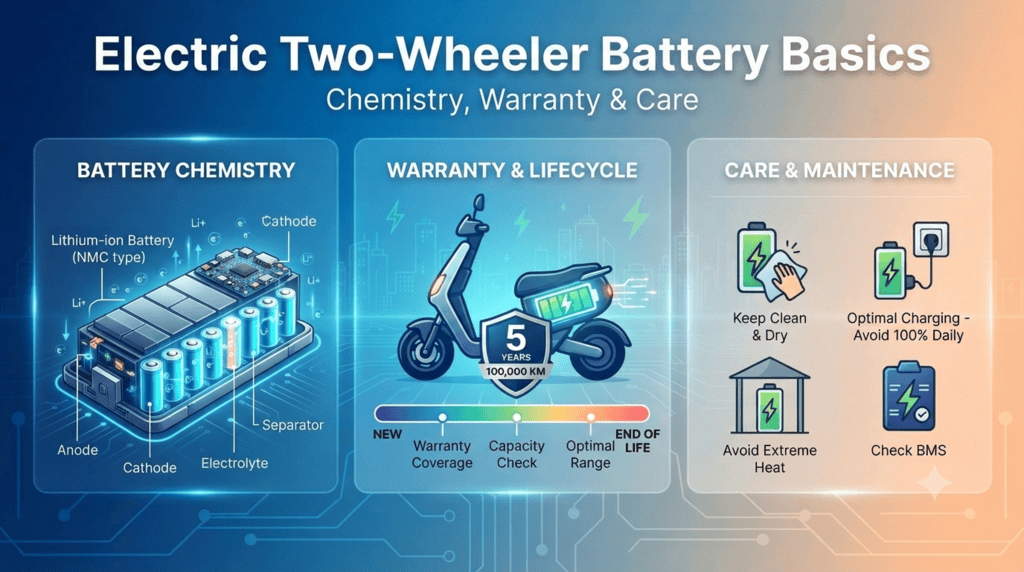
Electric Two-Wheeler Battery Basics: Chemistry, Warranty and Care

Key highlights
- NMC offers higher energy density, while LFP prioritises stability and longevity
- Check battery warranty limits, SoH guarantees and exclusions before buying
- Keep daily charging around 20-80% and avoid excessive heat
Outline
Ask a petrolhead about the heart of a motorcycle, and you will get a long chat about bore, stroke and cam timing. Switch to an electric two-wheeler, and that conversation moves somewhere else entirely, which is because the motor asks for almost nothing. The battery, though, decides your range, your resale value and how relaxed you feel leaving the scooter out in the May sun.
After spending sufficient time with both kinds of automobiles, something becomes obvious. Most people buying their first electric vehicle don’t realise how much the battery benefits from knowing a little something about it. You should really know what goes on in the pack, what is covered in your warranty (and what isn’t), and how to keep it all in good shape.
Why the Battery Is the Heart of an Electric Two-Wheeler
In a petrol bike, the engine is just one of the components among others, whereas the battery in an electric bike is the most expensive one, and the cost of replacing it takes away a lot from the total purchase price. Let's get started with some basic terms of a battery:
- kWh (kilowatt-hour): It is a unit of electrical energy equal to using 1 kilowatt (1,000 watts) of power for one hour. For example, 3 kWh will hold more energy than 2.2 kWh.
- Cells: Battery packs consist of numerous small cells that are connected in series/parallel combinations. Cell chemistry determines much of their performance and capabilities.
- BMS (Battery Management System): This is like the brain of the battery pack; it controls and monitors the parameters of all cell groups.
- SoH (State of Health): Capacity remaining relative to the original. The capacity determines how long you can drive on a single charge before the batteries require replacement.
- Charge cycle: Full battery cycle from empty to full. Two 50-100% charges equal approximately one charge cycle.
Safety regulations are much stricter now too. In light of several scooters catching fire in 2022, the Ministry of Road Transport and Highways revised the existing standard AIS 156 for the L-category. New rules were set up related to cells, BMS, on-board charger, pack design and thermal propagation. They came into force in two instalments on December 1, 2022, and March 31, 2023, respectively. Any scooter made by a popular brand is compliant with these regulations.
Battery Chemistry Explained: NMC vs LFP
Nearly every modern electric Two-Wheeler in India runs on lithium-ion cells. "Lithium ion" is a family name, though, and the two members you will meet most are NMC and LFP.
NMC Batteries
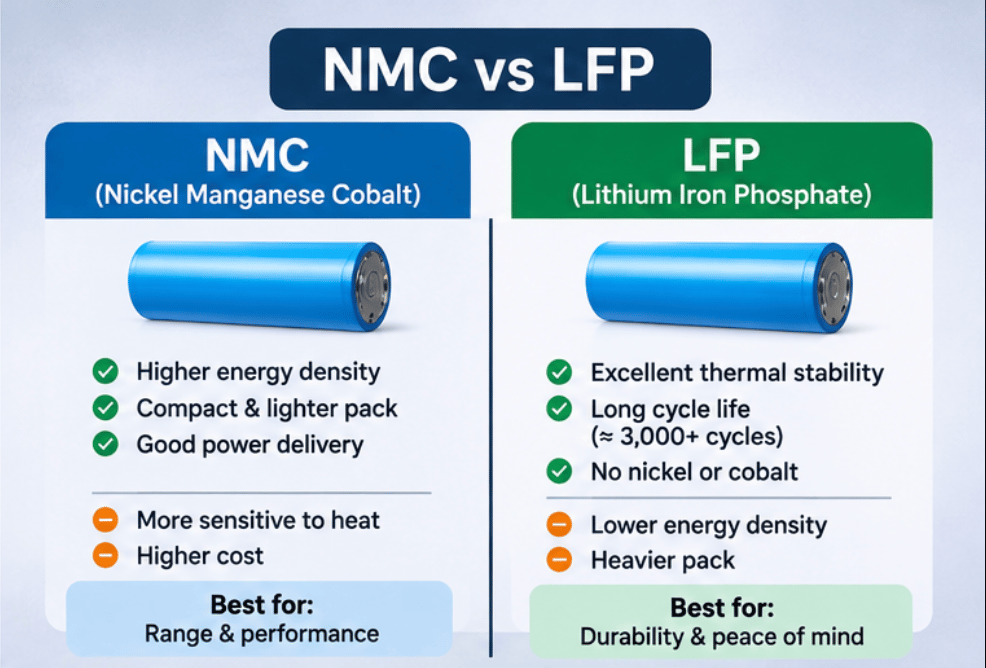
NMC stands for Nickel Manganese Cobalt. These batteries offer relatively high energy density, which allows manufacturers to develop compact battery packs without compromising too much capacity.
Their major advantages include:
- Higher energy density
- Compact battery packaging
- Good power delivery
- Established electric vehicle applications
However, temperature management and battery protection are important for long-term performance.
LFP Batteries
These Lithium Iron Phosphate batteries are known for their thermal stability and good cycle-life potential.
Their advantages include:
- Good thermal stability
- Long cycle-life potential
- No nickel or cobalt in the cathode
- Suitability for applications prioritising durability
However, LFP batteries usually have low energy density compared to NMC batteries, which might cause heavier batteries of the same capacity.
| Parameter | NMC | LFP |
| Energy density | Higher, lighter pack | Lower, heavier pack |
| Typical cycle life | Around 1,000 to 2,000 cycles | Around 3,000 cycles or more |
| Heat tolerance | Good, but more sensitive | Very stable |
| Cobalt content | Yes | None |
| Cost | Higher | Lower |
| Best suited to | Range- and performance-focused scooters | Riders who want long life and peace of mind |
These cycle numbers are approximate, as in real life they depend on the cell maker, the BMS tuning and how the scooter is used. A well-looked-after NMC pack can easily outlast a neglected LFP one.
So which one should you pick? Neither chemistry is universally superior, but if you ride long distances and care about performance, a good NMC pack still makes sense for you. But if you live somewhere properly hot, park outdoors and plan to keep the scooter for many years, LFP is very hard to argue with.
Battery Warranty on Electric Bikes and Scooters
Many buyers get caught out by the warranty printed in the brochure and the warranty they actually get. It can differ depending on the variant and the add-ons you pick.
Below is a glimpse of what the big names offer on battery warranty. However, these terms were checked in November 2026, and plans and prices change often, so confirm with the dealer before you pay.
| Brand and model | Standard battery warranty | Extended option |
| Ather 450 series and Rizta | 3 years or 30,000 km | Eight70 plan, up to 8 years or 80,000 km with Pro pack, bought within 90 days |
| TVS iQube | 3 years or 50,000 km (3 years or 30,000 km on 2.2 kWh) | Extra 2 years and 20,000 km bundled with TVS BaaS plans |
| Bajaj Chetak | 3 years or 50,000 km | Paid extension to 5 years or 70,000 km on the 35 Series |
| Ola S1 range | 3 years or 50,000 km | Paid top-ups up to 8 years or 1,25,000 km (S1 X 2 kWh excluded) |
What a battery warranty usually covers
Most policies cover manufacturing defects and outright failure of the pack. The better ones also guarantee capacity. For instance, Ather's Eight70 plan promises a free battery replacement if State of Health falls below 70% during the cover period.
What it usually doesn't cover
Physical damage, poor maintenance and negligent use are common exclusions. TVS spells this out plainly in its FAQ. Ather also excludes natural wear and tear. Unapproved modifications, third-party chargers and skipped service visits are other classic reasons for a claim getting rejected.
A few things worth checking on paper before you buy:
- Is the warranty limited by years, kilometres or whichever comes first?
- Does it promise a minimum State of Health, or only cover defects?
- Is the extended plan transferable when you sell the scooter?
- Is there a deadline to buy the extension? Ather's is 90 days from purchase.
- Who decides the SoH figure? Usually, it is the brand's own diagnostic tool.
Electric Two-Wheeler Maintenance: Battery Care That Actually Works
Starting with some good news. Electric Two-Wheeler maintenance requires much less work than a regular petrol bike, as there are no oil changes, spark plugs, or clutch cables. However, the battery will also depend on your behaviour. There are some do’s and don’ts to be taken care of:
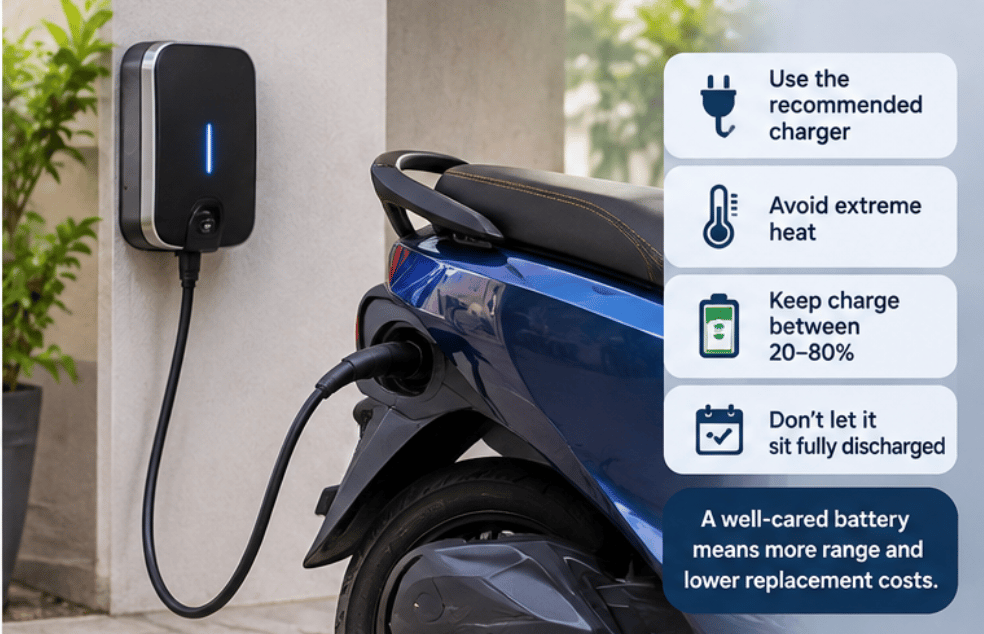
- Keep daily charging in the middle band. Lithium cells are happiest between roughly 20 and 80%. Running the pack to zero every day or parking it at 100% for long stretches adds stress. Charge to full before a long ride, by all means. Some brands also want an occasional full charge so the BMS can balance the cells, so check your owner's manual.
- Respect the heat, because it is the biggest enemy of any lithium battery. Park in the shade whenever you can. After a hard ride on a hot afternoon, give the pack some time to cool before plugging in.
- Use the charger that came with the scooter and plug it into a properly earthed socket. Cheap aftermarket chargers are a false economy and a common reason warranty claims go sideways.
- Don't overdo fast charging either. Public fast chargers are brilliant on a highway run. Using them every single day, especially in summer, builds extra heat. Home charging should be your default.
- Going away for a few weeks? Leave the battery somewhere near 50% and top it up roughly once a month. A pack that drains completely and sits that way can suffer serious damage.
- Be sensible with water. Many packs carry an IP67 rating, the TVS iQube being one example, so riding in the monsoon is fine. Wading through a flooded underpass up to the floorboard is a different story.
- And install software updates. Brands regularly tweak BMS logic and charging behaviour through over-the-air updates. Skipping them means missing out on genuine improvements.
Don't forget general bike care.
The battery gets all the attention, but fundamental maintenance is also important for electric bikes and scooters. Electric vehicles weigh more than petrol scooters and deliver instant torque, making the tyres and brakes work more intensively. Be sure to monitor tyre pressure once or twice a week. Also, don’t forget about brake pad wear and unusual sounds from the suspension.
Stick to the maintenance plan as well. For instance, TVS advises getting the iQube serviced at intervals of 4,000 km or four months. During service, it will be possible to perform a battery diagnostics procedure, and the obtained report will serve as good evidence in case a warranty claim needs to be filed.
Also read: Motorcycle Chain Maintenance: A Complete Guide
Warning Signs Your Battery Needs Attention
Some range loss over the years is normal, but a sudden or sharp change is not. Get the scooter checked if you notice any of these:
- Range drops noticeably in a few weeks, without a change in season or riding style
- The charge percentage jumps or falls suddenly, say from 40 to 15 in one go
- Charging takes much longer or finishes suspiciously quickly
- Battery temperature warnings or error codes on the dash
- Any swelling, unusual smell, hissing or heat from the battery area
One small note: Range does dip a little in cold weather as low temperatures slow down battery chemistry and increase riding resistance, though it climbs back once temperatures rise; it is not a fault.
Final Word
The feeling of having an Electric Two-Wheeler is somewhat comparable to having a quality mechanical watch. In the main, it requires little attention, but certain habits can help the device stay working much longer. Find out what type of battery chemistry your machine has and study the warranty carefully before exposing your device to high temperatures.