

 Riding Range
 Kerb WeightBraking System
 Max Power
 Top Speed

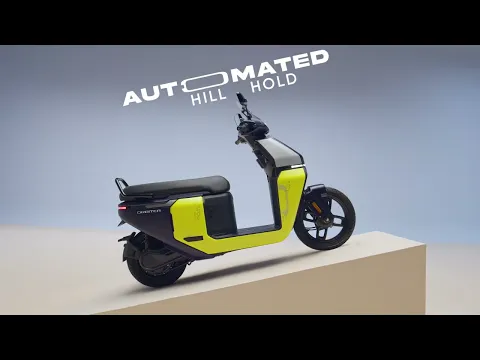
The TVS Orbiter wears a minimalist, slightly boxy design clearly aimed at younger riders and families alike. Large LED lights, a decently sized transparent windscreen, and curvy body panels give it a highly modern, urban appeal, even if the overall styling naturally reads as a touch less sleek than premium rivals like the Ather Rizta or Bajaj Chetak. Six striking colours are currently on official offer: Neon Sunburst, Cosmic Titanium, Stellar Silver, Martian Copper, Stratos Blue, and Lunar Grey. This effectively gives buyers a genuinely wide range of choice for an entry-level EV.
A vibrant 5.5-inch full-colour LCD with comprehensive smartphone integration elegantly anchors the cockpit. This system intelligently supports turn-by-turn navigation, geo-fencing, anti-theft alerts, and even vital crash notifications. This advanced feature set feels exceptionally confidence-inspiring and remarkably rare at this highly accessible price point. An 845 mm flat seat sits securely atop a massive 34 litres of underseat storage, which is large enough to comfortably hold two half-face helmets or a highly reasonable amount of daily luggage. This is a genuinely practical touch for everyday commuters. Electronic cruise control, convenient auto hill hold assist, and a dedicated reverse parking mode for tricky low-speed manoeuvres perfectly round off a premium feature list that easily punches well above what most standard rivals offer in this competitive segment.
The scooter's advanced connectivity suite consistently stands out as a particular technological strength. Several dedicated owners specifically praise the seamless smartphone integration as being significantly more comprehensive than anyone initially expected for an entry-level electric scooter. Furthermore, the large 14-inch front alloy wheel and 12-inch rear wheel ensure a highly planted, incredibly stable ride over predictably rough city roads. The impressive 169 mm of ground clearance easily allows riders to navigate large urban speed breakers without any annoying underbelly scraping.
| Feature | Detail |
| Instrument Console | 5.5-inch full colour LCD |
| Headlamp | LED |
| Colours | 6 |
| Underseat Storage | 34 litres |
| Seat Height | 760 mm |
| Connectivity | Geo-fencing, anti-theft, crash alerts |
The highly efficient TVS Orbiter actively utilises a responsive hub-mounted BLDC motor perfectly paired with a reliable 3.1 kWh lithium-ion battery in the premium V2 model. This advanced powertrain successfully delivers a certified IDC range of 158 km and a highly practical top speed of 68 kmph, with a 0 to 40 kmph acceleration time of just 6.8 seconds. TVS has also thoughtfully introduced a more accessible V1 variant equipped with a smaller 1.8 kWh battery pack, fully capable of delivering roughly 86 km on a complete charge, ensuring options for different commute lengths.
Owners frequently describe the smooth acceleration as completely seamless, with the instant torque delivery of modern electric motors, helping the TVS Orbiter feel highly responsive in dense stop-and-go city traffic. Two distinct riding modes, namely Eco and City, gives riders the ultimate flexibility to carefully balance overall battery efficiency against everyday riding fun. This is smartly accompanied by a dedicated reverse parking assist mode specifically tuned for effortless low-speed urban manoeuvres.
Independent reviewers, however, consistently note that the absolute outright performance is marginally subpar when compared directly to some high-performance rivals, which could potentially hinder incredibly quick overtaking manoeuvres in extremely dense traffic conditions. This represents a highly clear, deliberate engineering tradeoff that TVS has consciously made to keep the TVS Orbiter's final price genuinely accessible for the masses, effectively prioritising ultimate practicality and premium electronic features over sheer outright punch. Regenerative braking is intelligently included as a completely standard feature across the lineup.
This represents a genuinely useful addition at this accessible price point that several passionate owners specifically call out as not just a mere marketing gimmick, but something that meaningfully and significantly extends the riding range during regular stop-and-go urban commuting.
| Specification | Value |
| Motor Type | BLDC Hub Motor |
| Battery | 3.1 kWh (V2) / 1.8 kWh (V1) |
| Top Speed | 68 kmph |
| Riding Modes | Eco, City |
| Claimed Range | 158 km (V2) / 86 km (V1) |
| Charging Time | Approx. 4 hours 10 mins (V2) |
The premium suspension setup on the highly practical TVS Orbiter features traditional telescopic front forks and twin rear shock absorbers, meticulously tuned specifically for everyday urban city use. Dedicated owners generally describe the overall ride comfort as exceptionally good, smoothly absorbing impacts even on significantly rougher, heavily potholed city roads. The 760 mm seat height and an exceptionally well-designed overall ergonomics beautifully suit a genuinely wide range of rider heights, making it incredibly accessible and highly comfortable for both younger college riders and extended family use.
Dependable braking comes from highly reliable 130mm drum brakes located at both the front and rear wheels, seamlessly paired with an advanced combined braking system (CBS) for maximum on-road safety. While several enthusiastic owners specifically praise the durable drum setup's long-term reliability and extremely low maintenance costs, the complete lack of a front disc brake, even as an optional upgrade, is heavily flagged consistently as a genuine mechanical omission, given exactly how incredibly common disc brakes have quickly become even on entry-level electric vehicles today. The handling feels remarkably light, highly agile, and effortlessly manageable in dense traffic, with the straightforward hub motor layout effectively keeping things simple.
A few discerning owners have occasionally reported minor build quality niggles during the initial ownership period. The transparent front windscreen, while highly functional, has drawn somewhat mixed feedback from taller riders.
| Specification | Value |
| Front Suspension | Telescopic Forks |
| Rear Suspension | Twin Shock Absorbers |
| Front Brake | Drum |
| Rear Brake | Drum |
| Seat Height | 760 mm |
| Ground Clearance | 169 mm |
TVS officially claims an impressive 158 km certified IDC range for the flagship TVS Orbiter V2 model, but real-world efficiency figures naturally vary quite widely across diverse owner reviews. Several riders report the actual achievable range is much closer to 100 to 120 km, depending heavily on the selected riding mode, passenger weight, and local traffic conditions. The highly efficient Eco mode consistently delivers noticeably better range than the more aggressive City mode, a clear consumption pattern that several cost-conscious owners specifically highlight for maximising their daily commute. Complete battery charging takes roughly 4 hours and 10 minutes for a full 0-100 percent cycle on the V2 using the standard 650W home charger. This remains highly reasonable for this budget segment, although understandably slower than some premium rivals offering dedicated high-voltage fast charging options.
The standard running cost estimates confidently put the TVS Orbiter at approximately a remarkably low Rs. 0.21 per km, a genuinely fantastic figure that actively keeps daily urban commuting costs absolutely minimal for budget-conscious families. Furthermore, TVS uniquely offers a highly innovative Battery as a Service (BaaS) financing option on the TVS Orbiter. This flexible purchasing model brilliantly lets potential buyers significantly reduce the upfront purchase price in exchange for a highly affordable monthly battery rental subscription. This remains a fantastically flexible financial option, definitely worth considering, depending entirely on your individual daily usage patterns. Official service support generally draws highly positive feedback across the board, with dedicated owners frequently describing TVS's mechanical response as incredibly prompt and highly professional, successfully ensuring total peace of mind for buyers transitioning from petrol.
The highly accessible TVS Orbiter is officially offered in two distinct, well-equipped variants specifically tailored for the Indian market: the entry-level V1 and the premium V2. These models are differentiated almost entirely by their absolute battery size and their officially claimed maximum riding range, spread beautifully across six striking colour options. The TVS Orbiter price officially starts at an incredibly attractive Rs. 91,550 ex-showroom for the highly affordable V1 variant. Meanwhile, the significantly more capable V2 model, equipped with the massive 3.1 kWh battery pack, commands a justified Rs. 1,14,580 ex-showroom.
The actual on-road prices unsurprisingly vary quite significantly by cities across the country due to widely differing local state registration charges, highly variable EV subsidies, and mandatory comprehensive insurance premiums. For instance, enthusiastic New Delhi buyers typically end up paying remarkably close to Rs. 97,030 on the road for the base V1 variant, and approximately Rs. 1,15,310 for the fully loaded V2 model. It is always highly recommended to confirm the current pricing figures, active financing options, and applicable state EV subsidies with your nearest authorised TVS dealership before placing an official booking.
The highly affordable V1 variant perfectly suits budget-conscious buyers who desperately want the absolute most accessible entry into TVS Orbiter ownership. Conversely, the premium V2 suits dedicated commuters who genuinely need a significantly longer, worry-free range for demanding daily intercity travel.
The key direct rivals of Orbiter at highly competitive electric segment include the premium TVS iQube, the stylish VIDA VX2, and the incredibly popular OLA S1 X. However, the TVS Orbiter's incredibly strong electronic feature set, unmatched 34-litre storage, and incredibly low running costs absolutely keep it a genuinely strong, highly competitive value proposition today.
| Variant | Approx. Ex-showroom Price |
| TVS Orbiter V1 (1.8 kWh) | Rs. 91,550 |
| TVS Orbiter V2 (3.1 kWh) | Rs. 1,14,580 |
The TVS Orbiter price officially starts at Rs. 91,550 ex-showroom for the entry-level V1 variant, going all the way up to Rs. 1,14,580 for the premium V2 model. Total on-road prices in New Delhi are typically closer to Rs. 97,030 for the V1, and 1,15,310 for V2 variant, depending on insurance and subsidies.
TVS officially claims an IDC range of 158 km for the V2 variant, though owner-reported figures in regular daily riding often fall between 100 and 120 km, depending heavily on the specific riding mode used and traffic conditions.
No, the TVS Orbiter utilises standard 130mm drum brakes at both the front and rear wheels, seamlessly paired with a combined braking system (CBS). The complete absence of a disc brake option remains a commonly noted mechanical limitation.
The 0 to 100 percent charge takes approximately 4 hours and 10 minutes using the standard 650W home charger for the V2 variant, while the V1 variant's smaller battery successfully charges much faster.
The scooter is officially available in two distinct variants, V1 and V2, across six striking colours, including Neon Sunburst, Cosmic Titanium, Stellar Silver, Martian Copper, Stratos Blue, and Lunar Grey.
The TVS Orbiter is aggressively positioned as TVS's highly affordable, feature-rich entry-level EV, while the premium TVS iQube successfully offers slightly more refined performance, a more traditional family scooter design, and a significantly higher starting price.