



 Max Power
 Top Speed
 Max TorqueBraking SystemKerb Weight
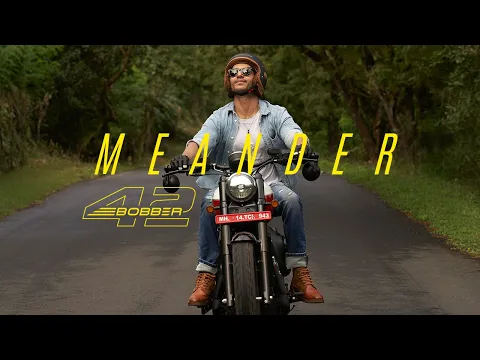
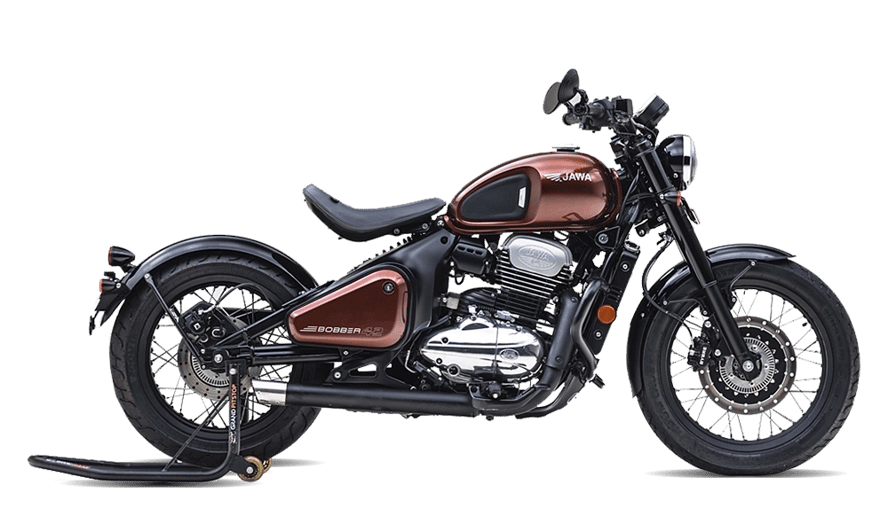
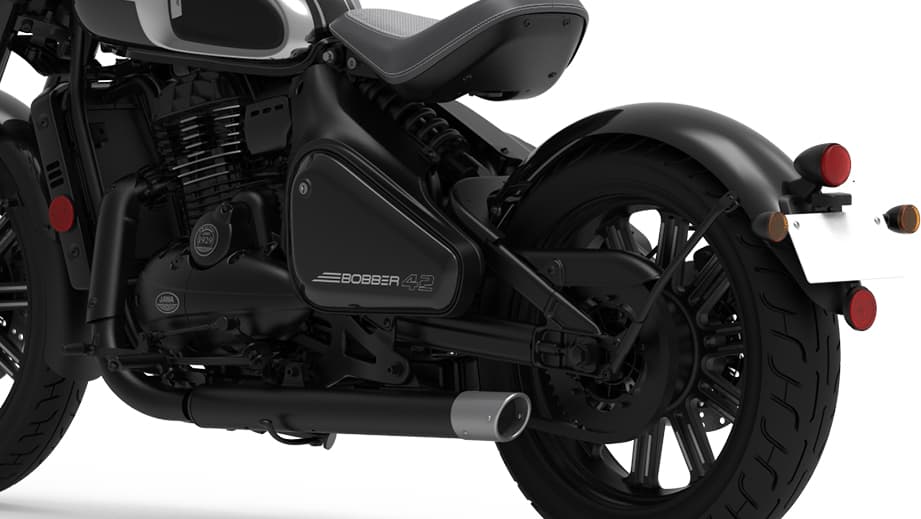
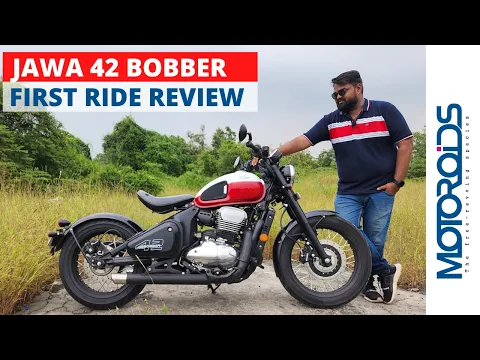
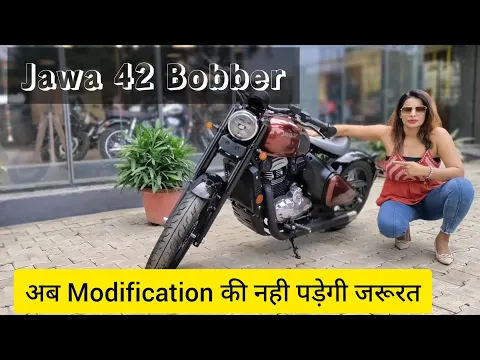
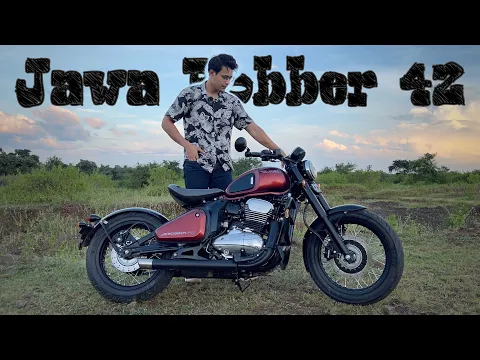
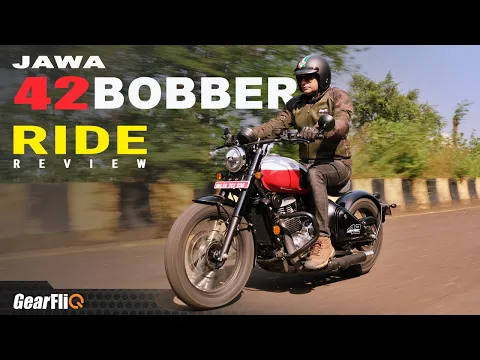
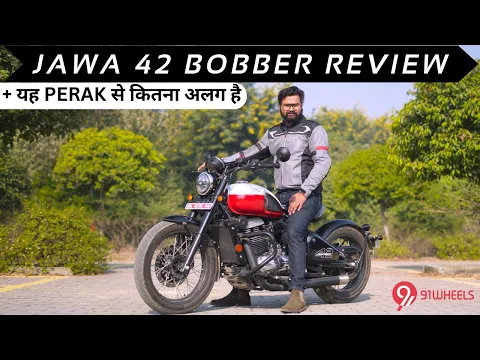
The Jawa 42 Bobber is built around core principles: stripped, low-slung, single-seat, minimal bodywork, engine-forward. The round headlamp, bar-end mirrors, exposed frame, and twin slash-cut exhausts fully deliver on that promise.
Two-wheel options define the variant split and are the primary choice buyers make. Spoke-wheel variants carry the classic Bobber look, referencing the 1950s café racer tradition. Alloy wheel variants feature a diamond-cut finish that adds a contemporary, premium character. Both look strong in person. Both read well in person, and the choice is largely personal.
The cantilever single seat is the most defining visual element of the design. It sits low over the rear wheel, hugging the tyre without a conventional subframe running beneath it. Standout colours include Mystic Copper, Jasper Red, and the Black Mirror with chrome tank and blacked-out finish. Seven colour options are available across the five-spoke and alloy variants, giving buyers a good range of choices.
The digital instrument cluster displays ride data, including trip meter, odometer, fuel level, and gear position. It is compact and unobtrusive, perfectly suited to the minimalist aesthetic. Clutter would undermine what the design is trying to achieve. Build quality is solid for the price. Some reviewers note that refinement falls slightly below Honda's and Royal Enfield's.
| Feature | Detail |
|---|---|
| Seat | Single cantilever seat |
| Headlamp | Round (halogen) |
| Exhaust | Twin slash-cut |
| Wheels | Wire spoke or diamond-cut alloy |
| Instrument Cluster | Digital |
| Available Variants | 5 |
| Available Colours | 7 |
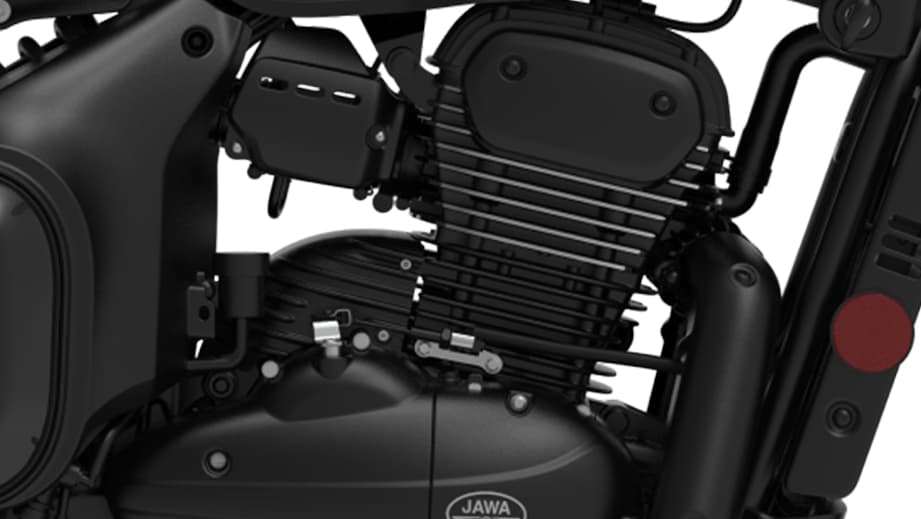
Inside the Jawa Bobber sits a 334cc liquid-cooled DOHC single-cylinder engine. It is the most powerful motor in the Jawa-Yezdi lineup. It produces 29.51 bhp at 7,500 rpm and 32.74 Nm of torque at 6,000 rpm. A 6-speed gearbox handles transmission with a light, precise action. These numbers are competitive with the Royal Enfield Meteor 350 and Honda CB350.
Liquid cooling gives the engine a thermal management advantage over the air-cooled RE and Honda rivals. In slow urban traffic, the engine stays cooler and runs more consistently. The DOHC layout allows freer breathing at higher revs, producing stronger top-end pull than SOHC alternatives.
The character of this engine is confident and eager. Power builds progressively through the rev range, with the strongest pull between 4,000 and 7,000 rpm. The note from the twin slash-cut pipes is one of the most praised aspects of the Jawa 42 Bobber. It is deep, purposeful, and satisfying without being antisocial.
Top speed is around 130 kmph. The engine is most comfortable between 60 and 100 kmph, which is the range most riders use on Indian highways. Long-term owners report that the engine retains its character well past 20,000 km with regular service.
| Specification | Value |
|---|---|
| Displacement | 334 cc |
| Max Power | 29.51 bhp at 7,500 rpm |
| Max Torque | 32.74 Nm at 6,000 rpm |
| Gearbox | 6-speed manual |
| Cooling | Liquid cooled |
| Engine Architecture | DOHC |
| Top Speed | 130 kmph |
The 740mm seat height is the Jawa 42 Bobber's most talked-about specification. It is one of the lowest seat heights on any 330cc-plus motorcycle in India. Most riders, regardless of height, can flatfoot with ease. The low seat and wide rear tyre create the classic posture: feet forward, body low, arms wide and relaxed. It is a genuinely comfortable position for relaxed city and highway riding.
The 35mm telescopic front forks and 7-step adjustable rear monoshock handle the suspension duties. The setup is firm, which suits the Bobber character and keeps the bike planted in corners. On rough roads and broken highway sections, the stiffness is felt. Some riders find it tiring on long stretches. The wide 140/70-17 rear tyre gives strong straight-line stability but reduces lean angle in corners.
At 185 kg, the Bobber bike is not light. The weight is felt at low speeds and during parking manoeuvres. Once moving, the mass is less of an issue, and the bike feels balanced and predictable. Braking uses dual front and rear disc brakes with dual-channel ABS. The 280mm front and 240mm rear setup provides strong stopping power with good feel.
There is no pillion seat. The Jawa 42 Bobber is a solo Bobber bike by design. The single-seat look is central to its identity.
| Specification | Value |
|---|---|
| Front Suspension | Telescopic forks, 35mm |
| Rear Suspension | Monoshock, 7-step adjustable |
| Front Brake | 280mm disc, dual-channel ABS |
| Rear Brake | 240mm disc, dual-channel ABS |
| Kerb Weight | 185 kg |
| Seat Height | 740 mm |
| Rear Tyre | 140/70-17 |
| Wheelbase | 1,485 mm |
Jawa 42 Bobber mileage is modest by segment standards. The liquid-cooled, higher-revving engine trades fuel economy for performance. ARAI-certified mileage is around 30 kmpl. Real-world owner reports consistently place returns at 28-33 kmpl in mixed conditions. City riding with frequent stops sits closer to 28 kmpl. City riding tends toward the lower end. Highway cruising at moderate throttle improves it toward 33 kmpl.
The 12.5-litre tank gives a range of around 350-400 km per fill-up under mixed conditions. Monthly fuel costs for 500 km of riding work out to roughly Rs. 1,600-1,900, depending on riding style. For a 334cc performance-focused motorcycle, those are acceptable and competitive running costs. Buyers in this segment well understand the trade-off in the economy between the engine's character and other factors.
Classic Legends has improved the Jawa-Yezdi service network considerably since the brand's 2018 relaunch. Service centres are now present across most cities and major towns. Service intervals are every 5,000 km. Spare parts pricing is reasonable for a premium segment bike. The warranty is 4 years/50,000 km as standard.
For weekend and holiday riders rather than daily commuters, the service network's reach is generally adequate. Urban owners anywhere in India will have no issues accessing authorised service. Buyers in smaller towns should verify the proximity of service centres. The network is not as dense as Honda or Royal Enfield in tier-3 areas.
The Jawa 42 Bobber starts at Rs. 1,95,395 ex-showroom for the Mystic Copper Spoke Wheel variant. The top Black Mirror and Red Sheen Alloy Wheel variant is Rs. 2,22,048. The Jawa Bobber 42 price range spans five variants within a Rs. 18,000 band.
| Variant | Approx. Ex-showroom Price |
|---|---|
| Moonstone White | Rs. 1,95,305 |
| Mystic Copper, Spoke Wheel | Rs. 2,04,113 |
| Jasper Red, Spoke Wheel | Rs. 2,04,888 |
| Mystic Copper and Jasper Red, Alloy | Rs. 2,13,050 |
| Black Mirror and Red Sheen, Alloy | Rs. 2,22,048 |
Spoke-wheel variants are the entry point for the more classic, traditional Bobber look. Alloy wheel variants add the diamond-cut finish and a more premium visual character. For those who prefer wire spokes, the base variants represent better value.
The Bobber 42 competes in a segment where Royal Enfield's service dominance is well established. Buyers who prioritise long-term ownership peace of mind over design exclusivity will find the Meteor 350 a safer choice. Those who want a motorcycle that stands apart from the Royal Enfield crowd will find the Bobber genuinely compelling.
The Bobber 42 directly competes with the Royal Enfield Meteor 350, Honda CB350, and Yezdi Roadster. Among those rivals, the Jawa is the only true Bobber. In terms of outright design differentiation and segment exclusivity, the Jawa 42 Bobber stands in a category of one. In terms of reliability, track record and service network, Royal Enfield and Honda have an established edge.
The Jawa 42 Bobber starts at Rs. 1,95,305 ex-showroom for the base spoke-wheel variant. The top alloy wheel variant is Rs. 2,22,048. The on-road price of the Jawa 42 will be higher by Rs. 20,000 to Rs. 35,000, depending on your state. Confirm the current price with your nearest Jawa dealer.
The Jawa 42 Bobber delivers around 30 kmpl mileage and is ARAI-certified. Real owners report 28 to 33 kmpl in mixed use. Highway riding at 70 to 90 kmph returns the better end.
No. The Jawa Bobber is a dedicated single-seater. The cantilever seat is core to the Bobber design. There is no pillion accommodation on any variant. Buyers who frequently carry a pillion should consider the standard Jawa 42 instead, which offers a two-seat setup.
The Jawa 42 Bobber produces more power and offers a more distinctive, focused design. The Royal Enfield Meteor 350 is more comfortable for touring, offers pillion seating, and has a more established service network. The Meteor suits touring-oriented buyers. The Bobber suits those who want design exclusivity and a solo riding experience.
The spoke variants carry wire wheels at a lower price for the traditional look. The Jawa Bobber 42 alloy variants feature diamond-cut wheels for a contemporary, premium look. Both share the same engine, frame, and mechanical setup.
The Jawa 42 Bobber comes in seven colours across five variants. Options include Mystic Copper, Jasper Red, and Black Mirror with Red Sheen. The Black Mirror variant has a chrome tank with a fully blacked-out finish and is the most popular choice.